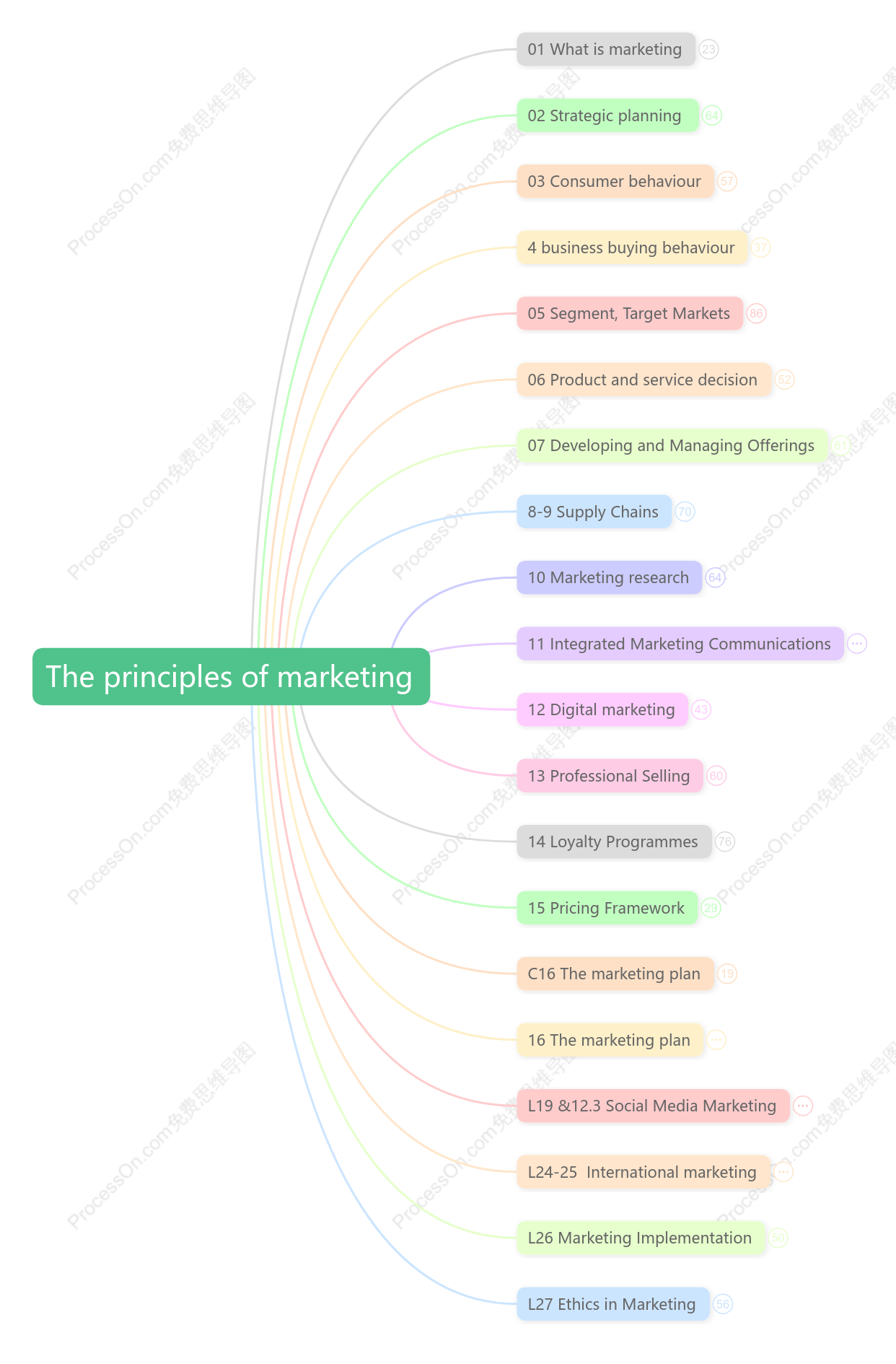
Principles of marketing_LU
2021-04-22 23:23:56 1 举报市场营销原理学习笔记,了解每一门学科,相关的名词解释以及名词之间的关系最关键。英语基础好的同学可以看一看。
拆书稿征集
Business
Channels
sales
Marketing
模板推荐
作者其他创作
大纲/内容
01 What is marketing
1.1defining marketing
1.2 Who does marketing
1.3 Why study marketing?
marketing enables profitable transactions to occur
Marketing delivers values
Marketing benefits society
to facilitate trade
to create jobs
to improve the quality of life
Marketing costs money
Marketing offers people job opportunities
Criticisms of marketing
1.4 Themes and organisation of this book
marketing's role in the organisation
Everything stars with customers
The marketing plan
The changing marketing environment
Digital information and big data
Ethics and social responsibility
Sustainability
Service-dominant logic
Mertics and analytics
A global environment
02 Strategic planning
2.1 The Value Proposition
supported by strategies
2.2 Components of the strategic planning process
Conducting a Situation Analysis
Conducting a SWOT Analysis
Assessing the Internal Environment
strong presence in global markets
the loyalty of a firm's employees
profitability
brand awareness
Assessing the External Environment
The Political and Legal Environment
The Competitive Environment
the five forces model
substitute products
potential entrants
the bargaining power of suppliers
the bargaining power of buyers
their direct competitors
Competitive Analysis
The Economic Environment
inflation
exchange rates
interest rates
unenployment rates
The Demographic and Social and Cultural Environments
Technology
the Internet
Mobile networking
online Ads
Natural Resources
green marketing
save water
less packing
renewable materials
The Mission Statement
2.3 Developing objectives and Formulating strategies
Developing Objectives
Formulating Strategies
Market Penetration strategies for EPEM
Product development strategies for NPEM
Market development strategies for EPNM(risk,investment, control)
Exporting
Licensing
Franchising
Contract Manufacturing
Joint Ventures
Direct Investments
Diversification strategies for NPNM
2.4 Where strategic Planning Occurs within Firms
corporate-level plans
business-level plans
functional (department) level
2.5 Strategic portfolio planning Approaches
The Boston Consulting Group Matrix
Stars for HSHG
Cash Cows for HSLG
problem children or question marks for LSHG
Dogs for LSLG
The BCG helps managers make resource allocation decisions
The General Electric Approach
Red
Yellow
Green
03 Consumer behaviour
3.1 Factors That Influence Consumer Behavior
Situational factors
atmospherics/physical factors
Controllable
layout, lighting, music, smell
none-Controllable
crowding
herd behaviour
weather
Time of purchase
social situation
sell sth to your neighbour
Sell sth at parties
reason for the Purchase
mood
Economic situation
personal factors
Personality and self-concept
Gender, age, and Stage of Life
Lifestyle
Psychological Factors
Motivation
Perception&Subliminal advertising
Learning
Attitude
Customer Satisfaction
Customer Dissatisfaction
Customer Loyalty
Behavioural Loyalty <br>
Attitudinal Loyalty <br>
Societal Factors
Culture
Cultural dimensions
Hofstede's
Social Class
reference Groups
Membership groups <br>
Aspiration groups <br>
Opinion leaders
Influencers
3.2 Customer's Decision-Making Process <br>
some concepts
Low-involvement decisions
Limited problem solving
High-involvement decisions
extended problem solving
routine response behaviour
Compluse buying
buying process
1 need recognition
2 search for product information
3 Product evaluation
4 Product choices and purchase
5 Postpurchase use and evaluation of product
6 Disposal of the product
Planned obsolescence
The customer's journey
4 business buying behaviour
4.1 the characteristics of B2B market
the numbers
Personall selling
very complex
huge amount of business
meet strict standards
Longer decision cycles
the influences
internal-Organizational
Factors inside the supplier organisation “the marketer” <br>
Factors inside the buying organisation “the target”<br>
external-environmental<br>
Laws & regulations <br>
Politics <br>
Bargaining power <br>
4.2 types of B2B buyers
producers
resellers
governments
institutions.
4.3 Buying centres
the professional buyers
initiators
Users
Influencers
gatekeepers
Deciders
4.4 stages in B2B buying process
1. A need is recognized
2. The need is described and quantified
3. Potential suppliers are searched for
4. Qualified suppliers are asked to complete responses to requests for proposal (RFPs)
5. The proposals are evaluated and supplier(s) selected.
6. An order routine is established.
7. A postpurchase evaluation is conducted and the feedback provided to the vendor
4.5 B2B e-commerce and social media marketing
4.6 International B2B market
05 Segment, Target Markets
Segmentation
what is ?
The process of breaking down all consumers into groups of potential buyers with similar characteristics
benefits
to facilitate the design of an effective marketing mix
to facilitate cost reduction by allcoating resources efficiently
to organise competition within the market
to enable marketers to prioritise their targeting stategies.
Bases of segmentation
Behavioural
Volume usage(heavy-moderate-light
Benefit expectations
Nutrition
Economy
Health
Good Taste
Performance
Prestige
How consumers use the product
Demographic
age
income
gender
Family life cycle
single or married
Kids at home or not
Age of kids
Age of family members
occupation
Education
Social class
religion
Ethnicity
Geographic
Where they are located
Region, urban, rural, City size, density
Geodamographics or neighborhood geography
Psycographic
AIO=activities, interests , and opinions
VALS=values, attitudes, and lifestyles
`innovators
Thinkers
achievers
experiencers
believers
strivers
makers
survivors
B2B segmentation
Geographic location
Industry
Customer size
Price-focused
Quality-focused
Service-focused
Partnership-focused
Targeting
Definition
Choosing one or more segments as the focus of marketing activities, and
identifying the appropriate Targeting strategy
Mass marketing
concentrated
Multi-segment
Niche
One-to-one
Benefits
To avoid head-on competition with other firms
To develop new offerings
To remarket old, less-profitable products
To identify early adopters.
Focus on most profitable customers
Retain "at-risk" customers
Characteristics of an attractive market segment
Sizeable enough
Can the market be profitable?
Growing
Is it a growing market?
Not too many competitors
Is there room for a new compepitor?
Is the market accessible?
The company has the required resources to compete in it
Are resources available to serve this market?
What is the fit with present business mission and objectives?
Positioning
repositioning
Perceptual map
06 Product and service decision
The Goods-services continuum
Goods-dominant Products (tangible
Sevices-dominant Products(Intangible)- RATER
Reliability
Assurance
Tangibility
Empathy
Responsiveness
The three poduct layers
1 Core product
2 Expected Product
3 Augmented product
Adding value to the Product marketing mix
Branding
Packaging
Functions
To protect & preserve
To meet the need of re-sellers
To present information
To provide convenience
To promote & attrace
To contain
Three types of packaging
Primary packaging for consumer
Secondary Packaging for retailer
Tertiary Packaging For retailer & wholesaler
Labelling
Quality
Reliability
Durability
Consistency of quality
Design
Features
Aesthetics
Product support services
Warranty
Installation
Toll-free telephone numbers
Delivery
After-sale service
Types of offerings
Consumer offerings
Convenience offerings
Shopping offerings
Speciality offerings
Unsough offerings
B2B offerings
Capital equipment offerings
Raw materials offerings
Original equipment manufacturer(OEM) offerings
Maintenance, repair& operations (MRO) offerings
Facilitating offerings
07 Developing and Managing Offerings
0 which is first?
Price?
designing product?
7.1 The New Offering Development Process
1 idea generation大胆假设
Sources
employees
Competitors
Suppliers
customers
Process
by chance
Crowdsourcing
Create a consumer discussion form
Conducting marketing research
2 idea screening 小心求证
process feasibility
Concept testing
depth interviews
Focus group
Added values to customers ?
financial feasibility
fit the company's image or coopreate strategies?
3 feature specification
narrowing down the product’s features
Quality function development
4 development
written specification
prototypes
the offering’s proposed strategy
manufacturing process
5 Testing
Alpha testing & Lab testing
Beta testing
Market test
6 Launch or Commercialization
rolling launch
7 Evaluation
7.2 Product life cycle
Introduct
Characteristics<br>
High costs with low profits
Objectives
awareness
try the product
the new value and benefits
Price
Promotion
Distribution
growth
Characteristics<br>
increasing sales and profits<br>
Objectives
Price
Promotion
Distribution
maturity
decline
Harvesting
Divesting
7.3 Marketing mix strategies
8-9 Supply Chains
8.1 Types of channel partners<br>
Brokers & Affiliates
Wholesales
Merchant Wholesalers or distributors
Manufacturers' Sales Offices or Branches
Retailers
8.0 Distribution Strategy
suitable to the business
Analyse the channel's dynamics<br>
Identify & assign different roles & functions
Determine the intensity of distribution<br>
Identify & analyse the feasibility of any integration opportunities
8.2 disintermediation
8.2 Multiple Channels and Alternate Channels
8.2 International Marketing Channels
8.4 Choosing channel partners and structure<br>
Type of customer<br>
Type of product<br>
Channel partner capabilities<br>
The business environment and technology<br>
Marketing channels of competitors<br>
Outsourcing channel partners<br>
8.5 Channel Dynamics
Channel power
Channel leaders
Channel conflict<br>
Vertical conflict<br>
Horizontal conflict<br>
8.3 Functions of channel partners<br>
Promoting the product<br>
Push strategy
Pull Strategy
Sorting & regrouping products<br>
Sharing marketing & other information<br>
demand planning
Forecasting more frequently<br>
Engaging in collaborative planning, forecasting, and replenishment (CPFR)<br>
Supply chain visibility<br>
Using a demand-planning software<br>
Storing & managing inventory<br>
cross docking
Inventory Control
Goal: avoid stockouts (and lost sales)<br>
Adequate level of ‘safety stock’<br>
Too much safety stock will...<br>
Just-in-time Inventory Systems
Product Tracking
RFID
Block chain
Transporting products<br>
Trucking
Water
Rail
Air
Pipelines and Wires
Assuming ownership risk<br>
8.5 Strategies
intensity of distribution
Intensive distribution<br>
Selective distribution<br>
Exclusive distribution<br>
based on
The nature of the brand<br>
The types and number of competitors<br>
The availability of retail choices
Exclusive distribution<br>
Vertical integration<br>
Forward integration<br>
Backward integration<br>
Horizontal integration<br>
10 Marketing research
10.0 gethering and using information
Marketing research
Market research
Market intelligence
Search Engines
Corporate Websites
Social Media
Publications
Trade shows and Associations
Salespeople
Suppliers and Industry Experts
Customers
10.1 Marketing information system
Transactional data
Data about individual customers
Big data
a system for recording internally genarated data and reports
analytics functions to help managers with their marketing decision making
a system for collecting marketing intelligence on an ongoing basis
A system for conducting and recording marketing research
10.2 Steps in the Marketing Research Process
1 define the problem or opportunity
2 design the research
Primary data
Secondary Data
Gauging the Quality of secondary data
Syndicated research
Scanner-based research
Data brokers
Types of Research Design
Exploratory research design
qualitative research
depth interviews
focus grop interviews
case study
ethnography
projective technique
quantitative research
descriptive research
phsiological measurements
causal research
Design the data collection forms
questionnaire design
Testing the questionnaire
Specify the sample
sample
probability sample
Nonprobability sample
convenience sample
sampling error
sampling frame
Collect the data
surveys
taking physical measurements
Observing people
Analyze the data
data cleaning
Writing the research report and present the findings
Title page
Table of contents
Executive Summary
Methodology and Limitations
Findings
Rcommendations
11 Integrated Marketing Communications
11.1 IMC-Benefits
Deliver marketing message to buyers through all communications
Needed because instant access to information through Internet and social media
Aims to build the brand and develop strong customers relationships
11.3 Factors influncing promotion mix
11.4 Message strategies
USP-Unique Selling Point
AIDA model
Message Characteristics
open-ended message
Close-ended message
Brand and Messaging
Logo and Brand
brand values
Visual design elements
Tagline
Key messages (unique selling points)
Tone of voice
Elevator pitch
Consistency is important
11.3 the communication process
Process
sender
encode
message channel
decode
receiver
Perceptual process
Interference & noise
Feedback
Promotions planning
identifying the promotion objectives
creating consumer awareness
improving store traffic and sales volumes
To stimulate demand
capturing a greater share of the market with a product
creating "buzz" for a product
strengthening the image of a company or a brand
differentiating a product from competing products
retaining customers and building brand loyalty
11.5 Determining the promotion budget
Percent-of- sales method
affordable method
objective and task method
competitve parity
11.2 Choosing the promotion tool(types)
11.6 Advertising
Media selection
Television
Visuals & Motion
Radio
Rely solely on audio
Internet
Ability to track, target customers, interactive
Out-of-home
Brief messages, frequently viewed
Newspaper
Low quality of colour
Magazine
Scented messages
Message design
The communication process-11.3
Advertising appeals
Fear
Humour
Sex
Music
Rationality
Emotions
Advertising techniques
Viral marketing
Shock advertising
USP
Scarcity
Rational & Emotional appeals
Classical conditioning
11.7 Public relations
press releases, articles, news conferences
cause-related marketing
Crisis Communication
Online reputation management
11.7 Sponsorships
pay money to sponsor someone, Sth, some group
consumers' positive attitude
Exclusive sponsorship is optimal
11.7 Product Placements
11.8 Push VS Pull strategies
11.6 Direct Marketing
Digital marketing
Professional selling
11.8 Trade promotions 'B2B'
Trade show
Conventions
Sales contests
Trade allowances
Advertising allowance
training
Free merchandise
push money
11.8 Consumer sales promotions
sample
coupons
Point-of- purchase displays
premium
Contests
Product demostrations
Experiential marketing
Loyalty programs
Rebates
Events
Social/influencers
Measuring the impact of promotion
Sales
Consumers' awareness
Analytics
Reach
Frequency
12 Digital marketing
Types of Digital Marketing
12.1 Email marketing
Ask a question
Personalize the email
Appeal to scarcity
Make a list
12.1 Search Engine Marketing
Pay-per-click Ads
Retargeting
12.2 E-Commerce Marketing
Conversion
Landing Page
Multivariate Testing
12.2 M-Commerce Marketing
SMS
MMS
QR code
Augmented reality
Virtual Reality
12.3 Social Media Marketing
Types of network
General purpose networks
Blogs
Microblogs
Social news sites
Review sites
Photo-sharing networks
Video-sharing networks
Social Media Marketing Challenges
Lack of Control
Noisy Channels
Timing Issues
Best Practices
Use Visuals
Use Humor and Fun When Appropriate
UGC
PGC
Strive for Authenticity
Make Messages Meaningful
native ads
Optimize Across Sites
Community manager
12.4 Measuring the Effectiveness
13 Professional Selling
13.1 The role professional salespeople play
What salespeople do
Create Value for customers
Establish & manage relationships with customers
Gathering Information
Types of selling positions
Order getters
Missionary Salespeople
Trade Salespeople
Prospectors
Account Managers
Order takers
Sales support
13.2 Customer Relationships and selling strategies
Types of Sales Relationships
Transactional
Functional
Affiliative
Strategic
Sales Strategies
Script-based selling
Needs-satisfaction selling
Consultative Selling
Strategic-partner Selling
Choosing strategy for the type and selling stage
The personal selling process
Pre-approach
Approach
Identify needs
Present
Handle Objections
Close
Implement & services
13.3 Sales Metrics(Measure)
The Sales Funnel/pipeline
Lead
Suspect
Prospect
Metrics used by salespeople
Revenues
Numbers of Prospects/suspects in the pipeline
Conversion ratios
How much money they will make
Metrics used by sales managers
13.4 Ethics in Sales and Sales management
Common Ethical Issues
Company Safeguards
Challenges Facing Sales Managers
13.5 Aligning Sales and Marketing
M for S
Marketing shortens the sales cycle
improving Conversion Ratios by Scoring Leads
S for M
Communicating Market Feedback
Monitoring the competition
13.6 Outsourcing the sales function
Types
Independent agents
Manufacturer's representative
ADs and Disads of Oursourcing
14 Loyalty Programmes
14.1 Customer Communities
Influencer Panels
Active Influencer
Interested
Heavy User
Loyal
Lead User
14.2 Loyalty Management
Defination
Marketing efforts that reward the customer for frequent purchases
Customer Loyalty
Behavioural Loyalty
Habitual purchases
Attitudinal Loyalty
Cause-related marketing
Characteristics of loyal customers
less expensive to market to
More likely to generate positive word of mouth
More willing to try a new product under the brand name
More willing to pay a premium
More likely to tolerate mistakes
Goals
stimulate consumers to purchase more frequently
Gather marketing intelligence
Differentiate your brand when there is brand parity in the market
Positive Effects
The longevity effect
The blocker effect
The spreader effect
The accelerator effect
Designing loyalty programmes
Monetary VS. non-monetary rewards
Product propostion support
Timing of reward redemption
Single Vs. multi-firm programmes
Criteria for Monitoring loyalty programmes
Good performance by a company
Responsiveness by a company
Clear benefits
Community development
Is the program achieving its objectives
Monitoring loyalty programmes
identify members
Target these members with special offers
Goal is to stimulate the frequent use of the programme
RFM analysis
Recency
Frequency
Monetary
14.3 Customer Satisfaction<br>
Satisfaction
a feeling that an offering meets a customer's expectations
Satisfaction strategies
Establishing appropriate expectations
postpurchase dissonance
customer satisfaction measurement system.
NPS (net promoters score)
complaint management strategies.
The communication gap
The knowledge gap
The standards gap
The delivery gap
14.4 Ethics & laws
sugging
caveat emptor
Spam
Legal Requirements
CAN-SPAM Act
Privacy Laws
Gramm-Leach-Bliley Act
Uniform Commercial Code (UCC)
Digital Millennium Copyright Act
BALANCE Act
Warranties and Promises
expressed warranty
implied warranty
15 Pricing Framework
Set price objectives<br>
Maximizing profit<br>
Maximizing Sales
Maximizing Market Share<br>
Maintaining the Status Quo<br>
Earning a targeted ROI
Analyse consumers'demand
Price elastic demand<br>
Price inelastic demand<br>
Demand for prestigious products<br>
Analyse any factors affecting pricing decision<br>
Customers' interpretation of the price<br>
Channel members'expectations<br>
Competitors<br>
Price competition<br>
Non-price competition<br>
Government laws and regulations<br>
Choose pricing technique<br>
Differential techniques<br>
New product techniques<br>
Product-line techniques<br>
Psychological techniques<br>
Promotional techniques<br>
Determine costs<br>
1 Calculate total costs<br>
2 Add a mark-up<br>
Conduct a break-even analysis<br>
Break-even point (BEP)<br>
Make price adjustments as needed<br>
C16 The marketing plan
Why marketing plans?
Direct the marketing effort – what needs to be done<br>
Specify the activities needed in order to implement & control marketing activities<br>
Provide direction for those with marketing related responsibilities<br>
Internal - Persuade the company's executives of an offering or approach so they will invest money, time, and effort in it<br>
Characteristics
It is created frequently<br>
It is a collective effort
It is a persuasive document (to tell a good story)<br>
It must be consistent and focused<br>
What is in a plan?
1 Executive summary
2 The business Challenge
3 Situation Analysis-SWOT
4 Goals or objectives
5 Marketing Strategy
6 Budget and Forecasting
7 Timeline and responsibility allocation
8 Monitoring mechanisms
16 The marketing plan
what is in a plan
1 executive summary
2 The business challenge
3 Situation Analysis
4 Goals or Objectives
5 Marketing Strategy
Target market
likely to be profitable
Relevant to objectives
Able to be reached
Select the product offering
Develop the communication plan
Messages
Content
Channels
Distribution plan
all the supply chain tactics
Partners and channel intermediaries
Transport and warehouseing
Outlets
6 Budget and Forecasting
Accuracy is important
Some tools
qualitative
quantitative techniques
Judgment techniques
sales force composite
Executive Opinion
Expert Opinion
Leading indicator
Time series techniques
Response models
market test
7 Timeline and responsibility allocation
8 Monitoring mechanisms
16.1 Marketing plan role
16.2 Functions of marketing plan
01 Executive summary
02 The business challenge
to influnence executives
to convice other people
to attact people outside
to answer questions "why should I invest in this plan?
03 The market
customers
company analysis
Competitors
Business climate (PEST)
Political climate
Government regulations
legislation
Economic climate
Inflation rate
unemployment rate
exchange rates
Social and cultural environment
Technological environment
04 The strategy
The strategy
The offering
The communication plan
Distribution plan
05 Budget
Investment
Return
Other resources required
06 Conclusion
16.3 Forecasting
steps
1 to determine market potentail
2 to estimate sales potentail
3 Judgement and survey techniques
customer surveys
executive or expert opinions
channel surveys
4 sales force composite
forecasting methods
Customer and Channel Surveys
advantages
disadvantages
Sales Force Composite
Executive Opinion
Expert Opinion
Time Series Techniques
Building Better Forecasts
Pick the Right Method(s) for Your Business and Your Decision
Use Multiple Methods
Use Many Variables
Use Scenario-Based Forecasts
Track Actual Results and Adjust
16.4 Ongoing marketing plan and evaluation
understanding causality
managerial control
statistical control
good execution of the marketing plan
whehter the marketing plans are actually implemented.
an examination of the implementation
fidelity-the degree to
16.5 Discussion Questions and Activities
16.6 Case study
L19 &12.3 Social Media Marketing
1 Requires a strategic approach
Benefits
Attract customers
increase your market reach
Do market research
Increase revenue
Develop your brand
exchange ideas to improve the way
Increase traffice to your website or SEO
Keep an eye on your competitors
But... Challenges
Requires resources to manage your online presence<br>
Social media is immediate and needs daily monitoring <br>
Unwanted or inappropriate behaviour on your site, including bullying and harassment online <br>
Exposure could attract risks such as negative feedback, information leaks or hacking<br>
Can’t control what others are saying about your business<br>
2 Goals
Brand awareness
Drive traffic to website
Generate new leads
Grow revenue (by growing audience)
Boost brand engagement
Build a community
Provide customer service
Engage with what others are saying about you
3 Channel Selection-platforms
Google.com
YouTube
Facebook
Trademe
Reddit
Google.co.nz
Netflix
Shopity
NZ Herald
Stuff
Linkedin
Wikipedia
4.1 Audience (who do you want to engage)
Who do you need to reach?<br>
Existing audience/mailing list?<br>
Describe – demographic, psychographic, geographic<br>
What are their pain points?<br>
What are they interested in?<br>
Where are they online? <br>
When are they online?<br>
Who do they listen to?<br>
Media<br>
Influencers<br>
Follows/Likes<br>
4.2 Building Audience (Content is King)
Invite to like through other channels<br>
Promoted social media messages<br>
Advertising (lookalike audiences)<br>
Competitions<br>
Organic: through shares and engagement <br>
5 Messages
Creating Value
Where will they get value? <br>
Creating content (your messages)<br>
Curating content (sharing others)<br>
User generated content (gold)<br>
What information will they get?<br>
What do you want them to do?<br>
What do you want to tell your audience?<br>
Creating Content
How will you deliver your message?<br>
Values, personality, tone of voice<br>
Format(Text, image, video)<br> – dependent on message and channel<br>
What content will work for your message?<br>
Have you defined your tone of voice and values? <br>
6 Social Media Influencers
Who ?
Individuals with a wide following on Social Media channels<br>
Audience engagement with posts more important than total followers<br>
Relevance of audience to your brand is more important than follower/engagement numbers
‘Buy' influencer social media comment (blog, tweet, post, image etc)<br>
Choosing Influencers<br>
Viral Advertising/SM<br>
7 Managing your Social Media
Frequency-How often should you post? <br>
Moderation-Responding to comments<br>
COPE-Create once, publish everywhere<br>
Policies
Implement
Brand, tone, message, guidelines
Remember Wheaton's law
User generated content, UGC or PGC
Types of network
General purpose networks
Blogs
Microblogs
Social news sites
Review sites
Photo-sharing networks
Video-sharing networks
Best Practices
Use Visuals
Use Humor and Fun When Appropriate
UGC
PGC
Strive for Authenticity
Make Messages Meaningful
native ads
Optimize Across Sites
Community manager
L24-25 International marketing
24.1 Introduction
Features
Intel' Marketing is more complicated
<br>Multiple external environments<br>
Legal, contracting and enforcement<br>
Knowledge of international regulations and requirements<br>
So why do we do it?
Strategic goal (management wants to)
Diversify risk<br>
Extend product life cycle – intro to new markets<br>
Small domestic market limits growth <br>
Seasonal products<br>
Historical Growth
Politics & relationships focused on trade<br>
The development of instantaneous international communication<br>
Improvements in cross-border transport and travel<br>
Increased awareness of other cultures / countries
24.2 Selecting a foreign market- 3D
Economic Attractiveness
Low tariffs or barriers to trade
High market growth
Consumers with high income
Low taxation/ tax breaks
Availability of personnel and labour
Availability of Managerial team
Good level of consumer demand
Availability and cost of water, power, transport, real estate
Availability and cost of raw materials, capital equipment
Positive country-of-origin effect
Similarity/ease of supply chain partners
Cultural Similarity
Generic cultural dimensions
Language
Spoken
Written
Official
Linguistic pluralism
Mass media
Religion
Sacred objects
Philosophical systems
Beliefs & norms
Taboos
Holidays
Values, Attitude toward:
work
wealth
change
risk taking
Politics & Identity
Individual freedoms
Democracy
Nationalism & history
Three broad Classifications of cultural values
Other-oriented
environment-oriented
self-oriented
Hofstede's cultural dimensions
Uncertainty Avoidance
High-Emphasises strong social conventions
Low-a more relaxed attitude to social conventions
Individualism VS Collectivism
self-efficiency
In-group harmony
Power distance
High-Emphasises social hierarchies
Low- social hierarchies are not very important
Time Orientation
Long-term: emphasises traditions and norms
Short-term: Emphasises pragmatism & innovations
Feminitity VS Masculinity
F-cooperation&consensus-oriented
M- competition & heroism
Indulgence Vs. Restraint
R- emphasises strict social traditions and norms
I-allows free satisfation of needs and wants
Market Opportunity(First Mover)
Advantages
Gain a higher market share compared to late entrants<br>
Acquire scare assets before others<br>
Get the best geographic spaces<br>
Build relationships and learn about the market first<br>
to capitalise on ability to establish brand loyalty<br>
Disadvantages
Late entrants can have a higher survival rate <br>
Others can learn from your experience to lower costs
and capture shifts in consumers'tastes.
24.3 Target marketing
Strategy: new & existing products or markets
How to involve in
From exporting to Direct investments
Tradeoff
Standardisation
Adaptation
Flexible Standardisation-Think globally, act locally<br>
24.4 Marketing Mix
Product
Packaging is the cheapest, quickest, & easiest way to adapt a product<br>
Price
lower
To gain market acceptance<br>
To counter the competitive advantage of local producers<br>
Customer buying power
higher
To compensate for the extra expenditures
Customer buying power<br>
Profitability <br>
Distribution
Difficult to break into existing supply chains<br>
Promotion
Language differences<br>
Government regulations<br>
Tastes & attitudes<br>
Back translation<br>
L26 Marketing Implementation
Strategy-Plan-Implementation
To help or to hinder?
Organisation culture
Definition
a shared mindset
Silo Mentality
one resists sharing infromation with others
lack of trust
Resistance to new ideas
attitude is of only the marketing team
passing the blame
Inconsistency in marketing implementation
Collaborative Mentality
Be collaborative to achieve the goals
trust & coordination
Marketing is the responsibility of all departments
more diverse thinking
learn from mistakes
Consistent messages
Organisation Structure
Departmentalisation<br>
Levels of Hierarchy<br>
Centralised v decentralised structure<br>
The Department based on
Marketing tasks (Functional)
Products
Regions
Types of Customers
Organisation Systems
Information System
Reward System
Planning System
People(marketing roles)
Enough
Right Skills and experience
need to outsourced
To upskill the team
to Be motivated
Three Graphs
Implementation plan
Gantt Chart
Budgeting
Personnel
Equipment
Location
Advertising
Trade Shows
Customer Service
Salespeople
Maintaining the amount of inventory
L27 Ethics in Marketing
Corporate Social Responsibility
People
Staff
Stakeholders
Customers
Community
Profit
Business
Economic viability
Planet
Water
Resources
Climate
Why behave ethically ? (benefits)
Negative or positive publicity<br>
Source of competitive advantage<br>
Maintain position against competitors<br>
Social licence to operate<br>
Attract new customers<br>
Increase brand loyalty and reduce switching<br>
Economic benefits (good practice can be cheaper)<br>
Green Marketing
What
Create or meet demand<br>
Social impact (not just 'green')<br>
Production <br>
Product disposal<br>
How
Create or meet demand<br>
Promotional tools<br>
Greenwashing<br>
Customers Rights
'Caveat emptor' school
'Caveat venditor' school
Ethics in Marketing
Price
Price Fixing
Price gouging
Price discrimination<br>
Promotion
Promotional techniques may be deceptive <br>
Advertising to children<br>
Advertising harmful products<br>
Paying money to lobbyists<br>
Bribery – where is the line? <br>
Use of data/targeting (Cambridge Analytica) and privacy<br>
Aggressive personal selling<br>
What's Ethical ?
Principles
Greatest happiness
Individual rights
Justice
Simple Ethical tests
The golden rule
The TV test
The professional ethic


Collect
Get Started

Collect
Get Started

Collect
Get Started

Collect
Get Started
评论
0 条评论
下一页

