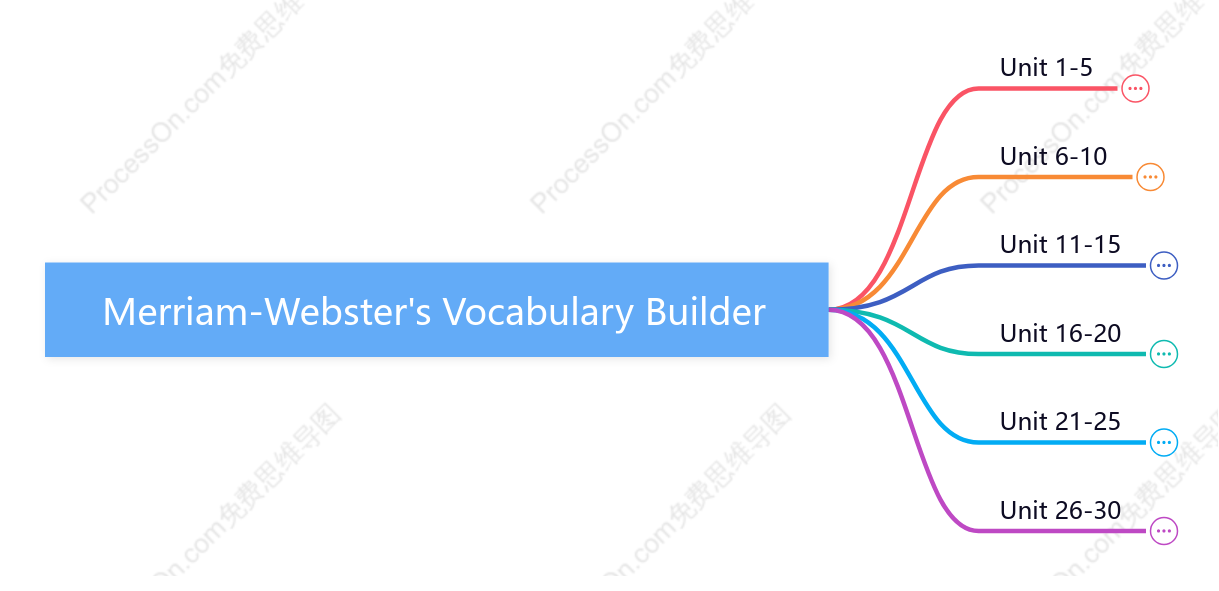
Merriam-Webster词汇
2021-08-05 20:11:47 1 举报韦小绿词根词缀学习
韦小绿
考研
英语
词根词缀
词汇量扩充
模板推荐
作者其他创作
大纲/内容
Unit 1-5<br>
Unit 1 <br>
BENE——“well”<br>
benediction(祝福;赐福;祈求上帝赐福的仪式):A prayer that asks for God's blessing, especially a prayer that concludes a worship service.
benefactor(恩人;捐助者;施主): Someone who helps another person or group, especially by giving money.
beneficiary(受益人,受惠者):A person or organization that benefits or is expected to benefit from something, especially one that receives money or property when someone dies.
benevolence(仁慈;善行):Kindness, generosity.<br>
AM——“to love”<br>
amicable(友好的;友善的):Friendly, peaceful.
enamored(迷恋的;倾心的):Charmed or fascinated;inflamed with love.
amorous(多情的;恋爱的;热情的;色情的):Having or showing strong feelings of attraction or love.
paramour(情夫,情妇;情人):A lover, often secret, not allowed by law orcustom.
BELL——“war”
antebellum((美国南北)战争前的):Existing before a war, especially before the American Civil War (1861-65)
bellicose(好战的;好斗的):Warlike, aggressive, quarrelsome.
belligerence(斗争性;好战性;交战):Aggressiveness, combativeness.
rebellion(叛乱;反抗;谋反;不服从):Open defiance and opposition, sometimes armed, to a person or thing in authority.
PAC——“agree”“peace”
pacify( 使平静;安慰;平定):(1) To soothe anger or agitation. (2) To subdue by armedaction.
pacifist(和平主义者):A person opposed to war or violence, especially someone who refuses to bear arms or to fight, on moral or religious grounds.
pact(协定;公约;条约;契约):An agreement between two or more people or groups; a treaty or formal agreement between nations to deal with a problem or to resolve a dispute.
pace((用于人名前,委婉提出不同意见)请…原谅):Contrary to the opinion of.
CRIM——“fault or crime”“accusation”
criminology(犯罪学;刑事学):The study of crime, criminals, law enforcement, and punishment.
decriminalize(使合法化;非刑事化):To remove or reduce the criminal status of.
incriminate(控告;暗示...有罪):To show evidence of involvement in a crime or a fault
recrimination(反责,反控;(互相)指责,批评(常复数)): (1) An accusation in answer to an accusation made against oneself. (2) The making of such an accusation.
PROB——“prove or proof”“honesty or integrity”
approbation(认可;赞许;批准):A formal or official act of approving;praise, usually given with pleasure or enthusiasm.
probate(遗嘱认证;处以缓刑):The process of proving in court that the will of someone who has died is valid, and of administering the estate of a dead person.
probity(廉洁;正直):Absolute honesty and uprightness.
reprobate(堕落的人,不道德的人;(加尔文教派用语)被上帝摈弃的人,无望受救赎者):A person of thoroughly bad character.
GRAV——“heavy, weighty, serious”
grave(重大的;严肃的;黯淡的;有沉音符的;(乐)缓慢的;墓穴,坟墓):(1) Requiring serious thought or concern. (2) Serious and formal in appearance or manner.
gravitas((拉)庄严;庄重;庄严的举止):Great or very dignified seriousness.
gravitate(受引力作用;被吸引):To move or be drawn toward something, especially by natural tendency or as if by an invisible force.
aggravate(加重;使恶化;激怒):(1) To make (an injury, problem, etc.) more serious or severe. (2) To annoy or bother.
LEV——“light”
alleviate(减轻,缓和):To lighten, lessen, or relieve, especially physical or mental suffering.
elevation(高地;海拔;提高;崇高;正面图):(1) The height of a place. (2) The act or result of lifting or raising someone or something.
cantilever(悬臂):A long piece of wood, metal, etc., that sticks out from a wall to support something above it.
levity(多变;轻浮;轻率;不稳定):Lack of appropriate seriousness.
Words from Mythology and History<br>
cicerone(导游,向导):A guide, especially one who takes tourists to museums, monuments, or architectural sites and explains what is being seen.
hector(恃强凌弱者;自吹自擂者):To bully or harass by bluster or personal pressure.
hedonism(享乐主义,寻欢作乐,纵欲):An attitude or way of life based on the idea that pleasure or happiness should be the chief goal.
nestor(内斯特;聪明的长者):A senior figure or leader in one's field.
spartan(斯巴达的;斯巴达式的;(生活方式)简朴的,清苦的):Marked by simplicity, avoidance of luxury, and often strict self-discipline or self-denial.
stentorian(声音洪亮的):Extremely loud, often with especially deep richness of sound.
stoic(坚忍克己者,坦然面对困难的人):Seemingly indifferent to pleasure or pain.
sybaritic(奢侈逸乐的;柔弱的):Marked by a luxurious or sensual way of life.
Unit 2 <br>
MANIA——“madness”
kleptomania(盗窃癖):A mental illness in which a person has a strong desire to steal things.
dipsomaniac(耽酒症患者):A person with an extreme and uncontrollable desire for alcohol.
megalomaniac(夸大狂患者;妄自尊大的人):A mental disorder marked by feelings of great personal power and importance.
egomaniac(极端自我主义者;极端利己主义者):Someone who is extremely self-centered and ignores the problems and concerns of others.
PSYCH——“breath,life,soul”
psyche(灵魂;心智):Soul, personality, mind.
psychedelic(迷幻剂;引起幻觉的):(1) Of or relating to a drug (such as LSD) that produces abnormal and often extreme mental effects such as hallucinations.(2) Imitating the effects of psychedelic drugs.
psychosomatic(身心的;身心失调的;身心治疗的):Caused by mental or emotional problems rather than by physical illness.
psychotherapist(精神治疗医师):One who treats mental or emotional disorder or related bodily ills by psychological means.
CEPT——“take,seize”
reception(接待;接收;招待会;感受;反应):(1) The act of receiving. (2) A social gathering where guests are formally welcomed.
intercept(拦截;截断;窃听):To stop, seize, or interrupt (something or someone) before arrival.
perceptible(可察觉的;可感知的;看得见的):Noticeable or able to be felt by the senses.
susceptible(易受影响的;易感动的;容许……的):(1) Open to some influence; responsive. (2)Able to be submitted to an action or process.
FIN——“end”“boundary”
confine(限制;禁闭;(因疾病、残疾)无法离开(床 、家、轮椅);将(自己或自己的活动)局限于;(妇女)卧床分娩):(1) To keep (someone or something) within limits. (2) To hold (someone) in a location.
definitive(最后的;最佳的;最权威的;(邮票)普通标准型的): (1) Authoritative and final. (2) Specifying perfectly or precisely.
finite(有限的;限定的):Having definite limits.
infinitesimal(无穷小的;无限小的;极小的):Extremely or immeasurably small.
JECT——“throw”“hurl”
interject(突然插入;插嘴):To interrupt a conversation with a comment or remark.
conjecture(推测;猜想):To guess.
projection(投射;规划;突出;发射;推测):An estimate of what might happen in the future based on what is happening now.
trajectory([物] 轨道,轨线;[航][军] 弹道):The curved path that an object makes in space, or that a thrown object follows as it rises and falls to earth.
TRACT——“drag or draw”
traction(牵引;[机][车辆] 牵引力):The friction that allows a moving thing to move over a surface without slipping.
retract(缩回;缩进;取消):(1) To pull back (something) into something larger. (2) To take back (something said or written).
protracted(拖延的;拖延;绘制;伸展):Drawn out, continued, or extended.
intractable(棘手的;难治的;倔强的;不听话的):Not easily handled, led, taught, or controlled.
DUC/DUCT——“to lead”
conducive(有益的;有助于…的):Tending to promote, encourage, or assist; helpful.
deduction(扣除,减除;推论;减除额):(1) Subtraction. (2) The reaching of a conclusion by reasoning.
induce(诱导;引起;引诱;感应):(1) Persuade, influence. (2) Bring about.
seduction(诱惑;魅力;(复数)诱惑物):(1) Temptation to sin, especially temptation to sexual intercourse. (2) Attraction or charm.
SEQU——“to follow”
sequential(连续的;相继的;有顺序的):(1) Arranged in order or in a series. (2 Following in a series.
subsequent(随后的):Following in time, order, or place; later
consequential(间接的;结果的;重要的;随之发生的;自傲的):(1) Resulting. (2) Important.
non sequitur(不合理的推论或结论):A statement that does not follow logically.from anything previously said.
Words from Mythology<br>
Apollonian(阿波罗神的;高尚的):Harmonious, ordered, rational, calm.
bacchanalian(酒神节的;狂饮作乐的):Frenzied, orgiastic.
delphic(暧昧的,隐晦的;意义不明确的):Unclear, ambiguous, or confusing.
Dionysian(酒神节的;狂欢的;狂饮的):Frenzied, delirious.
jovial(天性快活的;主神朱庇特的):Jolly, good-natured.
mercurial(水银的;水星的;墨丘利神的;雄辩机智的;活泼善变的):Having rapid and unpredictable changes of mood.
Olympian(奥林匹斯山的,奥林匹斯山诸神的;似神的,威严的,超脱世俗的;奥林匹克运动会的):Lofty, superior, and detached.
venereal(性病的,性交传染的;性交的):Having to do with sexual intercourse or diseases transmitted by it.
Unit 3<br>
AMBI——“on both sides”or“around”
ambiguous(模糊不清的,模棱两可的;不明确的,不明朗的;引起歧义的):(1) Doubtful or uncertain especially from being obscure or indistinct. (2) Unclear in meaning because of being understandable in more than one way.
ambient(周围的;外界的;环绕的;产生轻松氛围的):Existing or present on all sides.
ambivalent(矛盾的;好恶相克的):(1) Holding opposite feelings and attitudes at the same time toward someone or something. (2) Continually wavering between opposites or alternative courses of action.
ambit(范围;周围):The range or limit covered by something (such as a law).
EPI——“on,over”or“attached to”
epilogue(结语,收场白;尾声,后记):The final section after the main part of a book or play.
epiphyte(附生植物;体表寄生菌):A plant that obtains its nutrients from the air and the rain and usually grows on another plant for support.
epitaph(碑文,墓志铭):An inscription on a grave or tomb in memory of the one buried there.
epithet(绰号;浑名):(1) A descriptive word or phrase occurring with or in place of the name of a person or thing. (2) An insulting or demeaning word or phrase.
HYP/HYPO——“below,under”<br>
hypochondriac(疑病症):A person overly concerned with his or her own health who often suffers from delusions of physical disease.
hypoglycemia(低血糖症;血糖过低):Abnormal decrease of sugar in the blood.
hypothermia(降低体温;低体温症):Subnormal temperature of the body.
hypothetical(假设的;爱猜想的):(1) Involving an assumption made for the sake of argument or for further study or investigation. (2) Imagined for purposes of example
THERM/THERMO——“warm”
thermal(热的;热量的;保热的):(1) Of, relating to, or caused by heat. (2) Designed to insulate in order to retain body heat.
thermodynamics(热力学):Physics that deals with the mechanical actions or relations of heat.
thermonuclear( [核] 热核的;高热原子核反应的):Of or relating to the changes in the nucleus of atoms with low atomic weight, such as hydrogen, that require a very high temperature to begin.
British thermal unit(英国热量单位):The quantity of heat required to raise the temperature of one pound of water one degree Fahrenheit at a specified temperature.
POLY——“many”
polyp(息肉;珊瑚虫;水螅虫):(1) A sea invertebrate that has a mouth opening at one end surrounded by stinging tentacles. (2) A growth projecting from a mucous membrane, as on the colon or vocal cords.
polyglot(通晓(或使用)多种语言的;用多种语言写成的):(1) One who can speak or write several languages. (2) Having or using several languages.
polymer([高分子] 聚合物):A chemical compound formed by a reaction in which two or more molecules combine to form larger molecules with repeating structural units
polygraph(测谎器;复写器;多种波动描记器):An instrument for recording changes in several bodily functions (such as blood pressure and rate of breathing) at the same time; lie detector.
PRIM——“first”
primal(原始的;主要的;最初的):or primitive.
primer(初级读本;识字课本;原始物):(1) A small book for teaching children to read. (2) A small introductory book on a subject.
primate(灵长目动物(包括人、猴子等);大主教;首领):Any member of the group of animals that includes human beings, apes, and monkeys.
primordial(原始的;根本的;原生的):(1) First created or developed. (2) Existing in or from the very beginning
HOM/HOMO——“same”
homonym(同音异义词;同形异义词;同形同音异义词;同名异物):One of two or more words pronounced and/or spelled alike but different in meaning.
homogeneous(均匀的;[数] 齐次的;同种的;同类的,同质的):(1) Of the same or a similar kind. (2) Of uniform structure or composition throughout.
homologous(相应的;[生物] 同源的;类似的;一致的):Developing from the same or a similar part of a remote ancestor
homogenize(使均匀;使类同):(1) To treat (milk) so that the fat is mixed throughout instead of floating on top. (2) To change (something) so that its parts are the same or similar.
DIS——“apart”“opposite,not”
dissuade(劝阻,劝止):To convince (someone) not to do something.
disorient(使…迷惑;使…失去方向感):To cause to be confused or lost.
discredit(不信;使……丢脸):(1) To cause (someone or something) to seem dishonest or untrue. (2) To damage the reputation of (someone).
dislodge(逐出,驱逐;使……移动;用力移动):To force out of a place, especially a place of rest, hiding, or defense.
Latin Borrowings<br>
ad hoc(特别的;临时;专设):Formed or used for a particular purpose or for immediate needs.
ad hominem(诉诸人身;从个人偏好出发;个人的推论):Marked by an attack on an opponent's character rather than by an answer to the arguments made or the issues raised.
alter ego(密友;个性的另一面;至交):(1) A trusted friend or personal representative. (2) The opposite side of a personality.
de facto((法)实际上的):Being such in practice or effect, although not formally recognized; actual.
quid pro quo((拉丁)补偿物;相等物;交换条件;让步条件):Something given or received for something else.
ex post facto((拉丁语)事后的;(拉丁语)追溯的):Done, made, or formulated after the fact.
modus operandi((独特的)做法):A usual way of doing something.
modus vivendi(生活方式;临时协定;过渡办法):(1) A practical compromise or arrangement that is acceptable to all concerned. (2) A way of life.
Unit 4 <br>
VOR——“to eat”
carnivorous(食肉的;肉食性的):Meat-eating or flesh-eating.
herbivorous( [动] 食草的):Plant-eating.
insectivorous( [动] 食虫的,以虫类为食的;食虫动植物的):Feeding on insects.
voracious(贪婪的;贪吃的;狼吞虎咽的):Having a huge appetite.
CARN——“flesh”or“meat”
carnage(大屠杀;残杀;大量绝灭):Great destruction of life (as in a battle); slaughter.
carnal(肉体的;肉欲的;淫荡的;性欲的):Having to do with bodily pleasures.
incarnate(体现,化身为,使具体化;使人格化,拟人化;(人)体现(某种品质)):Given bodily or actual form; especially, having human body
reincarnation(再生;化身):(1) Rebirth in new bodies or forms of life. (2) Someone who has been born again with a new body after death.
CRED——“to believe”or“to trust”<br>
credence(信任;凭证;祭器台):Mental acceptance of something as true or real; belief.
credible(可靠的,可信的):(1) Able to be believed; reasonable to trust or believe.(2) Good enough to be effective.
credulity(轻信;易受骗):Readiness and willingness to believe on the basis of little evidence.
credo(信条,教义):(1) A statement of the basic beliefs of a religious faith. (2) A set of guiding principles or beliefs.
FID——“faith”or“trust”
affidavit(宣誓书):A sworn statement made in writing.
diffident(羞怯的;缺乏自信的;谦虚谨慎的):Lacking confidence; timid, cautious.
fiduciary(信托的;受信托的;基于信用的;受托人;被信托者):(1) Having to do with a confidence or trust. (2) Held in trust for another.
perfidy(不诚实;背信弃义):Faithlessness, disloyalty, or treachery.
CURR/CURS——“to run”
concurrent(并发的;一致的;同时发生的;并存的):Happening or operating at the same time.
cursory(粗略的;草率的;匆忙的):Hastily and often carelessly done.
discursive(散漫的;离题的;东拉西扯的;无层次的):Passing from one topic to another.
precursor(先驱,前导;(尤指经新陈代谢形成另一种物质的)前体,前质;前兆):One that goes before and indicates the coming of another.
PED——“foot”
quadruped(四足动物): An animal having four feet.
pedigree(血统;家谱;纯种的):The line of ancestors of a person or animal.
impediment(口吃;妨碍;阻止):Something that interferes with movement or progress.
<i>pedestrian</i>(行人;步行者;徒步的;缺乏想象力的):Commonplace, ordinary, or unimaginative.
FLECT——“to bend”
deflect(使转向;使偏斜;使弯曲):To turn aside, especially from a straight or fixed course.
reflective(反射的;反映的;沉思的):(1) Capable of reflecting light, images, or sound waves.(2) Thoughtful.
genuflect(屈服;跪拜(尤指做宗教仪式时)):To kneel on one knee and then rise as an act of respect.
inflection(弯曲,变形;音调变化):(1) A change in the pitch, tone, or loudness of the voice. (2) The change in form of a word showing its case, gender, number, person, tense, mood, voice, or comparison.
POST——“after”or“behind”
posterior(其次的;较后的):Situated toward or on the back; rear.
posthumous(死后的;遗腹的;作者死后出版的):(1) Published after the death of the author. (2) Following or happening after one's death.
postmodern(后现代的):Having to do with a movement in architecture, art, or literature that is a reaction against modernism and that reintroduces traditional elements and techniques in odd contexts as well as elements from popular culture.
postmortem(死后的;死后发生的;验尸):(1) Occurring after death. (2) Following theevent.
Words from Mythology<br>
calypso(卡利普索民歌(以时事为主题,流行于加勒比海地区);卡利普索音乐):A folk song or style of singing of West Indian origin that has a lively rhythm and words that are often made up by the singer.
odyssey(艰苦的跋涉;漫长而充满风险的历程):(1) A long, wandering journey full of trials and adventures. (2) A spiritual journey or quest.
palladium(钯(银白色稀有化学元素)):A precious, silver-white metal related to platinum that is used in electrical contacts and as an alloy with gold to form white gold.
Penelope(珀涅罗珀; 奥德修斯之妻,在奥德修斯远征时拒绝很多求婚者并始终忠于其夫):A modest domestic wife.
procrustean(强求一致的;迫使就范的;残暴的):Ruthlessly disregarding individual differences or special circumstances.
protean(千变万化的;一人演几个角色的;变形虫的):(1) Displaying great versatility or variety. (2) Able to take on many different forms or natures.
sibyl(女巫;女预言家):A female prophet or fortune-teller.
siren(汽笛;迷人的女人;歌声动人的女歌手):A woman who tempts men with bewitching sweetness.
Unit 5 P253<br>
MAL——“bad”
malevolent(adj. 恶毒的;有恶意的;坏心肠的):Having or showing intense ill will or hatred.
malicious(恶意的;恶毒的;蓄意的;怀恨的):Desiring to cause pain, injury, or distress to another.
malign((公开地)诽谤;有害的;邪恶的;(疾病)恶性的):To make harsh and often false or misleading statements<br>about.
malnourished(营养不良的;营养失调的):Badly or poorly nourished.
CATA——“down”
cataclysm(灾难;大洪水,地震;(社会政治的)大变动):(1) A violent and massive change of the earth's<br>surface. (2) A momentous event that results in great upheaval and often<br>destruction.
catacomb(地下墓穴;茔窟):An underground cemetery of connecting<br>passageways with recesses for tombs.
catalyst([物化] 催化剂;刺激因素):(1) A substance that speeds up a chemical reaction or<br>lets it take place under different conditions. (2) Someone or something that<br>brings about or speeds significant change or action.
catatonic(紧张性精神症的;紧张性精神症患者):(1) Relating to or suffering from a form of<br>schizophrenia. (2) Showing an unusual lack of movement, activity, or<br>expression.<br>
PROT/PROTO——“first in time”or“first formed”
protagonist(主角,主演;主要人物,领导者):The main character in a literary work.
protocol(协议;草案;礼仪;拟定):(1) A code of diplomatic or military rules of<br>behavior. (2) A set of rules for the formatting of data in an electronic<br>communications system.<br>
protoplasm(原生质;原浆;细胞质):The substance that makes up the living parts<br>of cells.
prototype(原型;样本;标准,模范;全真模型;[电]原型滤波网络;制作原型):(1) An original model on which something is<br>patterned. (2) A first, full-scale, usually working version of a new type or<br>design.
ANTE——“before”or“in front of”
antechamber(前厅;接待室;对燃室):An outer room that leads to another and is<br>often used as a waiting room.
antedate(先于;前于;比实际提前的日期):(1) To date something (such as a check) with a date<br>earlier than that of actual writing. (2) To precede in time.
antecedent(前情;祖先;(语法)先行词;前件;先前的;(语法)先行的):(1) A word or phrase that is referred to by a<br>pronoun that follows it. (2) An event or cause coming before something.
anterior(前面的;先前的):(1) Located before or toward the front or head. (2)<br>Coming before in time or development.<br>
ORTHO——“straight”“right”or“true”
orthodontics(畸齿矫正学,正牙术):A branch of dentistry that deals with the<br>treatment and correction of crooked teeth and other irregularities.
orthodox(正统的;传统的;惯常的;东正教的;正统的人;正统的事物):(1) Holding established beliefs, especially in<br>religion. (2) Conforming to established rules or traditions; conventional.<br>
orthopedics(矫形术,矫形外科学):The correction or prevention of deformities<br>of the skeleton.<br>
orthography(正确拼字;正字法;正字学):The spelling of words, especially spelling<br>according to standard usage.
RECT——“straight”or“right”
rectitude(公正;诚实;清廉):Moral integrity.
rectify(改正;精馏;整流):To set right; remedy.
rectilinear(直线运动的;形成直线的;用直线围着的):(1) Moving in or forming a straight line. (2)<br>Having many straight lines.<br>
directive(指示;指令;指导的;管理的):Something that guides or directs; especially, a general<br>instruction from a high-level body or official.
RU——“well”“good”“true”
eugenic(优种的;优生学的):Relating to or fitted for the production of good offspring<br>through controlled breeding.<br>
euphemism(委婉语;委婉说法):An agreeable or inoffensive word or<br>expression that is substituted for one that may offend or disgust.<br>
euphoria((常指较短时间的)极度兴奋,情绪高涨,狂喜):A strong feeling of well-being or happiness.
eulogy(悼词;颂词;颂扬;赞词):(1) A formal speech or writing especially in honor of a<br>dead person. (2) High praise.<br>
DYS——“bad”“difficult”
dystopia(糟透的社会;地狱般的处境;非理想化的地方):An imaginary place where people lead dehumanized<br>and often fearful lives.
dyslexia(难语症;[医] 诵读困难;阅读障碍):A disturbance or interference with the ability to<br>read or to use language.<br>
dyspeptic(消化不良的;患胃病的;胃弱的;暴躁的;易怒的;消化不良者):(1) Relating to or suffering from indigestion. (2)<br>Having an irritable temperament; ill-humored.
dysplasia(异型增生,发育不良,发育异常):Abnormal development of cells or organs, or an<br>abnormal structure resulting from such growth.<br>
Latin Borrowings<br>
a fortiori(更加;更不必说了,更有理由):All the more certainly.
a posteriori(归纳的;凭经验的):Relating to or derived by reasoning from<br>known or observed facts.
a priori(先天的;(拉)演绎的,推理的;先天地;演绎地;推理地):Relating to or derived by reasoning from self-evident<br>propositions.
bona fide(真实的;真诚的):(1) Made in good faith, without deceit. (2) Authentic<br>or genuine.
carpe diem((拉丁语)及时行乐,抓住今天):Enjoy the pleasures or opportunities of the<br>moment without concern about the future.<br>
caveat emptor(顾客留心(一经出售概不负责)):Let the buyer beware.
corpus delicti(犯罪事实):(1) The substantial and basic fact or facts<br>necessary to prove that a crime has been committed. (2) The material<br>substance, such as the murdered body, on which a crime has been committed.<br>
curriculum vitae((拉)简历):A short summary of one's career<br>and qualifications, typically prepared by an applicant for a position; résumé.<br>
Unit 6-10<br>
Unit 6 <br>
EQU——“equal”
equable(平静的;变动小的):(1) Tending to remain calm. (2) Free from harsh<br>changes or extreme variation.
adequacy(足够;适当;妥善性):Being equal to some need or requirement.
equilibrium(均衡;平静;保持平衡的能力):(1) A state in which opposing forces are<br>balanced so that one is not stronger or greater than the other. (2) A state of<br>emotional balance or calmness.
equinox(春分;秋分;昼夜平分点):A day when day and night are the same length.
QUIS——“to seek or obtain”
inquisition(调查;宗教法庭;审讯):A questioning or examining that is often<br>harsh or severe.
perquisite(额外补贴;临时津贴;特权):(1) A privilege or profit that is provided in<br>addition to one's base salary. (2) Something claimed as an exclusive<br>possession or right.<br>
acquisitive(贪得的;想获得的;可学到的;有获得可能性的):Eager to acquire; greedy.<br>
requisition(征用;要求;申请书;引渡要求;申请领取):A demand or request (such as for supplies)<br>made with proper authority.
PLE/PLEN——“to fill”
plenary(充分的;全体出席的;全体会议):(1) Including all who have a right to attend. (2)<br>Complete in all ways.
complement(补语;余角;补足物;补足,补助):(1) Something that fills up or makes perfect;<br>the amount needed to make something complete. (2) A counterpart.
deplete(耗尽,用尽;使衰竭,使空虚):To reduce in amount by using up.
replete(充满的;装满的;[昆] 贮蜜蚁):Fully or abundantly filled or supplied.
METR/METER——“measure”
metric(公制的;米制的;公尺的;度量标准):(1) Relating to or based on the metric system. (2) Relating<br>to or arranged in meter.<br>
meter(米;仪表;[计量] 公尺;韵律;用仪表测量):(1) The basic metric unit of length, equal to about 39.37<br>inches. (2) A systematic rhythm in poetry or music.<br>
odometer((汽车的)里程表,[车辆] 里程计):An instrument used to measure distance traveled.<br>
tachometer(转速计,转速表):A device used to measure speed of rotation.
AUD——do with hearing<br>
auditor(审计员;听者;旁听生):A person who formally examines and verifies financial<br>accounts.
auditory(听觉的;听众;礼堂):(1) Perceived or experienced through hearing. (2) Of<br>or relating to the sense or organs of hearing.<br>
audition(对演艺人员的)面试,试演;听觉,听能;试演,试唱;对(某人)进行面试,让(某人)试演(或试唱、试音)):A trial performance to evaluate a performer's skills.
inaudible(听不见的;不可闻的):Not heard or capable of being heard.
SON——“sound”
sonic(音速的;声音的;音波的):(1) Having to do with sound. (2) Having to do with the speed<br>of sound in air (about 750 miles per hour).<br>
dissonant(刺耳的;不谐和的;不调和的):(1) Clashing or discordant, especially in music. (2)<br>Incompatible or disagreeing.
resonance([力] 共振;共鸣;反响):(1) A continuing or echoing of sound. (2) A<br>richness and variety in the depth and quality of sound.
ultrasonic([声] 超声的;超音速的;超声波):Having a frequency higher than what can be<br>heard by the human ear.
ERR——“to wander”or“to stray”
errant(不定的;周游的;错误的;偏离正路的):(1) Wandering or moving about aimlessly. (2) Straying<br>outside proper bounds, or away from an accepted pattern or standard.
aberrant(异常的;畸变的;脱离常轨的;迷乱的):Straying or differing from the right, normal, or natural<br>type.
erratic(不稳定的;古怪的;漂泊无定的人;古怪的人):(1) Having no fixed course. (2) Lacking in consistency.<br>
erroneous(错误的;不正确的):Mistaken, incorrect.<br>
CED——“to proceed”or“to yield”
cede(放弃;割让(领土)):To give up, especially by treaty; yield.
concede(承认;退让;给予,容许;让步):To admit grudgingly; yield.<br>
accede(加入;同意;就任):(1) To give in to a request or demand. (2) To give approval<br>or consent.
precedent(先例;前例;在前的;在先的):Something done or said that may be an example<br>or rule to guide later acts of a similar kind.
Words from Mythology and History<br>
Augean stable(奥吉斯国王的牛舍;污秽腐败之所):A condition or place marked by great<br>accumulation of filth or corruption.<br>
Croesus(克里萨斯王(吕底亚国最后一位国王);大富豪):A very rich person.<br>
dragon's teeth(相互争斗的根源;龙之齿):Seeds of conflict.
Hades(冥府;地狱;阎王):The underground home of the dead in Greek mythology.<br>
lethargic(无精打采的,懒洋洋的;昏睡的):(1) Lazily sluggish. (2) Indifferent or apathetic.
Midas touch(点石成金(书名)):The talent for making money in every venture.<br>
Pyrrhic victory(付出极大代价而获得的胜利):A victory won at excessive cost.
stygian(阴暗的,幽暗的;地狱的):Extremely dark, dank, gloomy, and forbidding.<br>
Unit 7 <br>
VIS——“see”
vista(远景,狭长的街景;展望;回顾):(1) A distant view. (2) An extensive mental view, as over a<br>stretch of time.
vis-à-vis(关于;与……比较;与……相对;面对面地;共同地):In relation to or compared with.
visionary(有远见的;宗教幻觉的;空想的;梦想的;有眼光的人;出现宗教幻觉的人;梦想家):(1) A person with foresight and imagination. (2)<br>A dreamer whose ideas are often impractical.
envisage(设想,想象;正视,面对):To have a mental picture of; visualize.
SPECT——“to look at”
aspect(方面;方向;形势;外貌):(1) A part of something. (2) A certain way in which<br>something appears or may be regarded.
prospect(前途;预期;景色;勘探,找矿):(1) The possibility that something will happen in the<br>future. (2) An opportunity for something to happen.<br>
perspective(观点;远景;透视图;透视的):(1) Point of view; the angle, direction, or standpoint from which a person looks at something. (2) The art or technique of painting or drawing a scene so that objects in it seem to have depth and distance.<br>
prospectus((学校的)简章;(企业的)招股章程):A printed statement that describes something<br>(such as a new business or a stock offering) and is sent out to people who<br>may be interested in buying or investing.
VOC——“voice”“speak”
equivocate(说模棱两可的话;支吾, 躲闪;推诿;含糊其词):(1) To use ambiguous language, especially in<br>order to deceive. (2) To avoid giving a direct answer.
irrevocable(不可改变的;不能取消的;不能挽回的):Impossible to call back or retract.<br>
advocate(提倡,拥护;为……辩护;拥护者;辩护者;辩护律师,出庭律师;律师;为(某团体)谋利益者):To speak in favor of.
vociferous(大声叫的,喊叫的,喧嚷的;激昂的):Making noisy or emphatic outcries.<br>
PHON——“sound”“voice”or“speech”
phonics(声学;拼读法,声音基础教学法):A method of teaching beginners to read and pronounce<br>words by learning the characteristic sounds of letters, letter groups, and especially syllables.
phonetic(语音的,语音学的;音形一致的;发音有细微区别的):Relating to or representing the sounds of the spoken<br>language.
polyphonic(多音的;有韵律变化的;对位法的):Referring to a style of music in which two or<br>more melodies are sung or played against each other in harmony.<br>
cacophony(刺耳的音调;不和谐音):Harsh or unpleasant sound.
CUR——“care for”
curative(有疗效的;治病的;药品;治疗法):Having to do with curing diseases.<br>
curator(馆长;监护人;管理者):Someone in charge of something where things are on<br>exhibit, such as a collection, a museum, or a zoo.<br>
procure(获得,取得;导致):To get possession of; obtain.
sinecure(闲职;挂名职务):A job or position requiring little work but usually<br>providing some income.
PERI——“around”
perimeter(周长;周界;[眼科] 视野计):The boundary or distance around a body or figure.
periodontal(齿根膜的,牙周的):Concerning or affecting the tissues around<br>the teeth.<br>
peripatetic(漫游的;逍遥学派的;走来走去的人;逍遥学派的人):(1) Having to do with walking. (2) Moving or<br>traveling from place to place.
peripheral(外围的;次要的;(神经)末梢区域的;外部设备):(1) Having to do with the outer edges, especially of<br>the field of vision. (2) Secondary or supplemental.
SENS——“feeling”or“sense”
sensor(传感器):A device that detects a physical quantity (such as a<br>movement or a beam of light) and responds by transmitting a signal.
desensitize(使不敏感;使麻木不仁):To cause (someone or something) to react less<br>to or be less affected by something.<br>
extrasensory(超感官的,超感觉的):Not acting or occurring through any of<br>the known senses.<br>
sensuous(感觉上的,感官方面的;吸引人的;愉悦感官的;肉感的,性感的):(1) Highly pleasing to the senses. (2) Relating to<br>the senses.<br>
SOPH——“wise”“wisdom”
sophistry(诡辩;诡辩法):Cleverly deceptive reasoning or argument.
sophisticated(复杂的;精致的;久经世故的;富有经验的;使变得世故;使迷惑;篡改):(1) Having a thorough knowledge of the<br>ways of society. (2) Highly complex or developed.<br>
sophomoric(一知半解的;大学或四年制中学的二年级的):Overly impressed with one's own knowledge,<br>but in fact undereducated and immature.<br>
theosophy(神智学;通神学):A set of teachings about God and the world based<br>on mystical insight, especially teachings founded on a blend of Buddhist and<br>Hindu beliefs.
Words from Mythology and History<br>
Achilles' heel(唯一的致命的弱点):A vulnerable point.<br>
arcadia(世外桃源;阿卡狄亚(古希腊一山区,人情淳朴,生活愉快)):A region or setting of rural pleasure and peacefulness.
Cassandra(凶事预言家;不为人所信的预言家;卡珊德拉(希腊神话人物)):A person who predicts misfortune or disaster.<br>
cyclopean(巨大的;巨石式的;乱石堆):Huge or massive.
draconian(严厉的,苛刻的):Extremely severe or cruel.<br>
myrmidon(家仆;部下;忠实的追随者):A loyal follower, especially one who executes<br>orders unquestioningly.
nemesis(<正式>给予惩罚的人;宿敌,死对头;报应,天罚):A powerful, frightening opponent or rival who is<br>usually victorious.
Trojan horse(特洛伊木马;特洛伊木马(一种计算机病毒);用于掩盖真实目的或意图的人或事):Someone or something that works from within<br>to weaken or defeat.
Unit 8 <br>
PORT——“to carry”
portage(搬运;运输;转到陆上运输):The carrying of boats or goods overland from one body of<br>water to another; also, a regular route for such carrying.
portfolio(公文包;文件夹;证券投资组合;部长职务;作品集;(公司或机构提供的)系列产品,系列服务;(职业类型)短期合同制的,兼职的):(1) A flat case for carrying documents or artworks.<br>(2) The investments owned by a person or organization.<br>
comport(行为;举动;相称;适合;一致):(1) To be in agreement with. (2) To behave.<br>
deportment(举止;行为;态度):Manner of conducting oneself socially.
PEND——“to hang”or“to weigh”
pendant(垂饰,坠饰;吊灯;短索;补充作品;三角旗;下垂的):Something that hangs down, especially as an<br>ornament.<br>
append(附加;贴上;盖章):To add as something extra.
appendage(附加物;下属;[动][解剖] 附器(如植物的枝叶和动物的腿尾)):(1) Something joined on to a larger or more<br>important body or thing. (2) A secondary body part, such as an arm or a leg.<br>
suspend(延缓,推迟;使暂停;使悬浮;悬浮;禁赛):(1) To stop something, or to force someone to give up<br>some right or position, for a limited time. (2) To hang something so that it is free on all sides.
PAN——“all, completely, whole, general”
panacea(灵丹妙药;万能药):A remedy for all ills or difficulties; cure-all.<br>
pandemonium(一片混乱;闹哄哄的场所):A wild uproar or commotion.<br>
pantheism(泛神论;多神教):A system of belief that regards God as<br>identical with the forces and laws of the universe.
panoply(华丽服饰;全套甲胄,全副盔甲):(1) A magnificent or impressive array. (2) A display<br>of all appropriate accessory items.<br>
EXTRA——“outside”“beyond”
extradite(引渡;获取…的引渡):To deliver an accused criminal from one place to<br>another where the trial will be held.
extrapolate(外推;推断):To extend or project facts or data into an area<br>not known in order to make assumptions or to predict facts or trends.
extrovert(外向;外倾者;性格外向者(等于extravert)):A person mainly concerned with things outside<br>him- or herself; a sociable and outgoing person.
extraneous(外来的;没有关联的;来自体外的):(1) Existing or coming from the outside. (2)<br>Not forming an essential part; irrelevant.
PHOT——“light”
photoelectric([电子] 光电的):Involving an electrical effect produced by<br>the action of light or other radiation.
photovoltaic([电子] 光电伏打的,光电的):Involving the direct generation of electricity<br>when sunlight or other radiant energy falls on the boundary between<br>dissimilar substances (such as two different semiconductors).<br>
photon([物] 光子;辐射量子;见光度(等于light quantum)):A tiny particle or bundle of radiant energy.<br>
photosynthesis(光合作用):The process by which green plants use<br>light to produce organic matter from carbon dioxide and water.
LUC——“light”
lucid(明晰的;透明的;易懂的;头脑清楚的):(1) Very clear and easy to understand. (2) Able to think<br>clearly.
elucidate(阐明;说明):To clarify by explaining; explain.<br>
lucubration(刻苦钻研;苦心而成的著作):(1) Hard and difficult study. (2) The<br>product of such study.<br>
translucent(透明的;半透明的):Partly transparent; allowing light to pass<br>through without permitting objects beyond to be seen clearly.
MOR/MORT——“to die”“death”
mortality(死亡数,死亡率;必死性,必死的命运):(1) The quality or state of being alive and<br>therefore certain to die. (2) The number of deaths that occur in a particular<br>time or place.
moribund(垂死的;停滞不前的;垂死的人):(1) In the process of dying or approaching death.<br>(2) Inactive or becoming outmoded.<br>
amortize(摊销(等于amortise);分期偿还):To pay off (something such as a mortgage) by<br>making small payments over a period of time.<br>
mortify(抑制;苦修;使…受辱;禁欲;苦行;约束;腐坏):(1) To subdue or deaden (the body) especially by selfdiscipline or self-inflicted pain. (2) To embarrass greatly.<br>
TROPH——“nourishment”
atrophy(萎缩,萎缩症;发育停止):(1) Gradual loss of muscle or flesh, usually because of<br>disease or lack of use. (2) A decline or degeneration.<br>
hypertrophy([病理] 肥大;过度增大):(1) Excessive development of an organ or part.<br>(2) Exaggerated growth or complexity.<br>
dystrophy(营养障碍;营养失调):Any of several disorders involving the nerves and<br>muscles, especially muscular dystrophy.<br>
eutrophication(富营养化;超营养作用):The process by which a body of<br>water becomes enriched in dissolved nutrients.
Words from Mythology and History<br>
aeolian harp(风弦琴):A box-shaped instrument with strings that<br>produce musical sounds when the wind blows on them.<br>
cynosure(指针;众人瞩目的焦点):(1) A guide. (2) A center of attention.<br>
laconic(简洁的,简明的):Using extremely few words.<br>
mnemonic(记忆的;助记的;记忆术的):Having to do with the memory; assisting the<br>memory.
platonic(理想的;柏拉图哲学的;不切实际的;纯精神友谊的):(1) Relating to the philosopher Plato or his teachings.<br>(2) Involving a close relationship from which romance and sex are absent.<br>
sapphic(沙弗诗体的;沙弗风格的;有沙弗风格的诗):(1) Lesbian. (2) Relating to a poetic verse pattern associated<br>with Sappho.
Socratic(古希腊哲学家)苏格拉底的;问答法的;(古希腊哲学家)苏格拉底的信徒):Having to do with the philosopher Socrates or with his<br>teaching method, in which he systematically questioned the student in<br>conversation in order to draw forth truths.
solecism(语法错误,文理不通;谬误,失礼):(1) A grammatical mistake in speaking or writing.<br>(2) A blunder in etiquette or proper behavior.<br>
Unit 9 <br>
HER——“to stick”
adherent((政党、思想的)拥护者;粘着的;遵守的;(植物)联生的):(1) Someone who follows a leader, a party, or a<br>profession. (2) One who believes in a particular philosophy or religion.
cohere(凝聚;连贯;粘着;一致):To hold together firmly as parts of the same mass.
incoherent(语无伦次的;不连贯的;不合逻辑的):(1) Unclear or difficult to understand. (2)<br>Loosely organized or inconsistent.
inherent(固有的;内在的;与生俱来的,遗传的):Part of something by nature or habit.
FUG——“to flee or escape”
centrifugal([力] 离心的;远中的;离心机;转筒):Moving outward from a center or central<br>focus.<br>
refuge(避难;避难;所;庇护;给予…庇护;接纳…避难):Shelter or protection from danger or distress, or a place that<br>provides shelter or protection.<br>
fugue(赋格曲;神游症;作赋格曲):A musical form in which a theme is echoed and imitated by<br>voices or instruments that enter one after another and interweave as the piece<br>proceeds.
subterfuge(托词;借口;诡计):(1) A trick designed to help conceal, escape, or<br>evade. (2) A deceptive trick.
COSM——“order”<br>
cosmos(宇宙;和谐;秩序;大波斯菊):(1) The universe, especially when it is viewed as<br>orderly and systematic. (2) Any orderly system that is complete in itself.<br>
cosmology([天] 宇宙论,[天] 宇宙学):(1) A theory that describes the nature of the<br>universe. (2) A branch of astronomy that deals with the origin and structure<br>of the universe.
microcosm(微观世界;小宇宙;作为宇宙缩影的人类;缩图(等于microcosmos)):Something (such as a place or an event) that<br>is seen as a small version of something much larger.
cosmopolitan(世界性的;世界主义的,四海一家的;见多识广的;四海为家者;世界主义者;世界各地都有的东西):(1) Having international sophistication and experience. (2) Made up of persons, elements, or influences from many different parts of the world.<br>
SCI——“to know”or“to understand”
conscientious(认真的;尽责的;本着良心的;小心谨慎的):(1) Governed by morality; scrupulous.<br>(2) Resulting from painstaking or exact attention.
nescience(无知;不可知论):Lack of knowledge or awareness: ignorance.<br>
prescient(预知的;有先见之明的):Having or showing advance knowledge of what is<br>going to happen.<br>
unconscionable(不合理的;昧着良心的;肆无忌惮的;过度的):(1) Not guided by any moral sense;<br>unscrupulous. (2) Shockingly excessive, unreasonable, or unfair.<br>
JUNCT——“to join”
juncture(接缝;连接;接合;特定时刻,关头;交接处,接合点;音渡):(1) An important point in a process or activity. (2) A<br>place where things join: junction.
adjunct(附属物;助手;修饰语;附属的;<北美>(大学教师职位)临时的,副的):Something joined or added to another thing of which it is<br>not a part.<br>
disjunction(分离;析取;分裂;折断):A break, separation, or sharp difference<br>between two things.
conjunct(结合的,连接的;与连和有关的;合的;结合物;合取;连接副词):Bound together; joined, united.<br>
PART——“part”
bipartite(双边的;由两部分构成的;一式两份的;双方的):(1) Being in two parts. (2) Shared by two.<br>
impartial(公平的,公正的;不偏不倚的):Fair and not biased; treating or affecting all<br>equally.
participle(分词):A word that is formed from a verb but used like<br>an adjective.<br>
partisan(党派的;效忠的;偏袒的;盲目推崇的;游击队;虔诚信徒;党羽):(1) A person who is strongly devoted to a particular<br>cause or group. (2) A guerrilla fighter.<br>
MIS——“to send”
mission(使命,任务;代表团;布道;派遣;向……传教):(1) A task that someone is given to do, especially a<br>military task. (2) A task that someone considers an important duty.
missionary(传教的;传教士的;传教士般的;传教士):A person undertaking a mission, and especially<br>a religious missionary.
emissary(使者;间谍;密使;间谍的;密使的):Someone sent out to represent another; an agent.
transmission(传动装置,[机] 变速器;传递;传送;播送):(1) The act or process of sending something<br>from one point to another, especially sending electrical signals to a radio,<br>television, computer, etc. (2) The gears by which the power is passed from<br>the engine to the axle in a motor vehicle.<br>
PEL——“to move or drive”
compel(强迫,迫使;强使发生):(1) To force (someone) to do something. (2) To make<br>(something) happen.<br>
expel(驱逐;开除):(1) To drive or force out. (2) To force to leave, usually by<br>official action.
impel(推动;驱使;激励):To urge or drive forward by strong moral force.<br>
repel(击退;抵制;使厌恶;使不愉快):(1) To keep (something) out or away. (2) To drive back.
Words from Mythology<br>
arachnid(蛛形纲动物的;蛛形纲动物):A member of the class Arachnida, which principally<br>includes animals with four pairs of legs and no antennae, such as spiders,<br>scorpions, mites, and ticks.<br>
calliope(蒸汽笛风琴):A musical instrument similar to an organ in which<br>whistles are sounded by steam or compressed air.
dryad(德律阿得斯(希腊神话中的树神)):A wood nymph.
fauna(动物群;[动] 动物区系):Animal life, especially the animals that live naturally in a<br>given area or environment.<br>
flora(植物区系;植物群):Plant life, especially the flowering plants that live naturally in a<br>specific area or environment.
herculean(力大无比的;困难的;赫拉克勒斯的):(1) Extremely strong. (2) Extremely extensive,<br>intense, or difficult.
Pandora's box(潘多拉盒子;灾难之源):A source of many troubles.<br>
Scylla and Charybdis((前面与between连用)进退两难):Two equally dangerous<br>alternatives.<br>
Unit 10 <br>
PUT——“to think”
reputed(号称的,普遍认为的;名誉好的;认为(repute 的过去式和过去分词)):Believed to be a certain way by popular opinion.
disrepute(不光彩,坏名声):Loss or lack of good reputation; disgrace.<br>
impute(归罪于,归咎于;嫁祸于):To attribute.<br>
putative(推定的,假定的):Generally supposed; assumed to exist.
LOG——“word”“speech”or“reason”
physiology(生理学;生理机能):(1) A branch of biology dealing with the<br>processes and activities by which living things, tissues, and cells function. (2)<br>The life processes and activities of a living thing or any of its parts.
methodology(方法学,方法论):A set of methods or rules followed in a<br>science or field.
ideology(意识形态;思想意识;观念学):The set of ideas and beliefs of a group or political<br>party.
cardiology([内科] 心脏病学):The study of the heart and its action and<br>diseases.<br>
TERR——“earth”
parterre(花坛;花圃;正厅后座):(1) A decorative garden with paths between the beds of<br>plants. (2) The back area of the ground floor of a theater, often under the<br>balcony.
subterranean(地下的;秘密的;隐蔽的;地下工作者):Underground.
terrarium(玻璃容器;陆地动物饲养所):An enclosure, usually transparent, with a layer of<br>dirt in the bottom in which plants and sometimes small animals are kept<br>indoors.
terrestrial(地球的;陆地的,[生物] 陆生的;人间的;陆地生物;地球上的人):(1) Having to do with Earth or its inhabitants. (2)<br>Living or growing on land instead of in water or air.
MAR——“sea”
marina(码头,[船] 小艇船坞;散步道):A dock or harbor where pleasure boats can be moored<br>securely, often with facilities offering supplies or repairs.
aquamarine([宝] 海蓝宝石;碧绿色,浅绿色):(1) A transparent blue or blue-green gem.<br>(2) A pale blue or greenish blue that is the color of clear seawater in sunlight.
mariner(水手;船员):A seaman or sailor.
maritime(海运的,航海的,海事的;近海的,沿海的):(1) Bordering on or having to do with the sea. (2)<br>Having to do with navigation or commerce on the sea.
PATH——“feeling”or“suffering”
pathos((境况、文章、艺术品或人的)感染力;同情,怜悯;痛苦,受难):(1) An element in life or drama that produces sympathetic<br>pity. (2) An emotion of sympathetic pity.
apathetic(冷漠的;无动于衷的,缺乏兴趣的):(1) Showing or feeling little or no emotion. (2)<br>Having no interest.
empathy(神入;移情作用;执着;感同身受;共鸣):The feeling of, or the ability to feel, the emotions<br>and sensations of another.<br>
telepathic(心灵感应术的):Involving apparent communication from one<br>mind to another without speech or signs.
PEN/PUN——“penalty”“to punish”
penal(刑事的;刑罚的):Having to do with punishment or penalties, or institutions<br>where punishment is given.
impunity(不受惩罚;无患;[法] 免罚):Freedom from punishment, harm, or loss.
penance(忏悔;苦修;苦差事;使忏悔;使苦修):An act of self-punishment or religious devotion to show<br>sorrow or regret for sin or wrongdoing.<br>
punitive(惩罚性的;刑罚的):Giving, involving, or aiming at punishment.
MATR/MATER——“mother”
maternity(母性,母道;[妇产] 妇产科医院;产科的;产妇的,孕妇的):The state of being a mother; motherhood.
matriarch(女家长;女统治者;女负责人;受人尊敬的妇女):A woman who controls a family, group, or<br>government.
matrilineal(母系的):Based on or tracing the family through the<br>mother.
matrix(矩阵;模型;社会环境;基质;母体;子宫;脉石):(1) Something (such as a situation or a set of conditions)<br>in which something else develops or forms. (2) Something shaped like a pattern of lines and spaces.<br>
AQU——“water”
aquaculture([水产] 水产养殖;水产业):The farming of plants and animals (such as<br>kelp, fish, and shellfish) that live in the water.
aquanaut(海底观察员;海底实验室工作人员):A scuba diver who lives and works both inside and<br>outside an underwater shelter for an extended time.
aqueduct([水利] 渡槽;导水管;沟渠):(1) A pipe or channel for water. (2) A bridgelike<br>structure for carrying water over a valley.
aquifer((美)蓄水层;含水土层):A layer of rock, sand, or gravel that can absorb and<br>hold water.<br>
Words from Mythology<br>
cereal(谷类,谷物;谷类食品;谷类植物;谷类的;谷类制成的):(1) A plant that produces grain that can be eaten as food, or<br>the grain it produces. (2) The food made from grain.<br>
Junoesque((女子)高大匀称的;像朱诺般雍容华贵的):Having mature, poised, and dignified beauty.<br>
martial(军事的;战争的;尚武的):Having to do with war and military life.<br>
Promethean(普罗米修斯的;用于开创的;不畏权势的;不受约束的;如普罗米修斯般的人):New or creative in a daring way.
Sisyphean(永远做不完的;徒劳的):Endless and difficult, involving many<br>disappointments.
titanic(巨大的;四价钛的;泰坦尼克号):Having great size, strength, or power; colossal.<br>
Triton(特里同(人身鱼尾的海神)):(1) A being with a human upper body and the lower body of<br>a fish; a merman. (2) Any of various large mollusks with a heavy, conical shell.
vulcanize(硫化;硬化(等于 vulcanise)):To treat crude or synthetic rubber or plastic so that it<br>becomes elastic and strong and resists decay.<br>
Unit 11-15<br>
Unit 11<br>
CANT——“sing”
cantata(大合唱;(意)清唱剧;康塔塔(一种声乐套曲)):A musical composition, particularly a religious work<br>from the 17th or 18th century, for one or more voices accompanied by instruments.
incantation(咒语):(1) A use of spells or verbal charms spoken<br>or sung as part of a ritual of magic. (2) A formula of words used in, or as if<br>in, such a ritual.
cantor(合唱指挥家;独唱者):An official of a Jewish synagogue who sings or chants the<br>music of the services and leads the congregation in prayer.<br>
descant(独立高音旋律;评论;演唱独立高音旋律;最高音的):An additional melody sung above the principal melody.
LINGU——“tongue”“language”
linguistics(语言学):The study of human speech.<br>
multilingual(使用多种语言的;使用多种语言的人):Using or able to use several languages.
lingua franca(通用语;混合语;共通语):A language used as a common or<br>commercial language among peoples who speak different languages.<br>
linguine(意大利扁面条):A narrow, flat pasta.<br>
SPIR——“breath”“breathe”
spirited(精神饱满的,热情洋溢的;意志坚定的;有某种特定性格(或人生观、情绪)的;激烈的;偷偷带走,(神秘地或秘密地)窃走(spirit 的过去式和过去分词)):Full of energy or courage; very lively or determined.<br>
dispiriting(令人沮丧的;使人气馁的;使沮丧;使气馁(dispirit的ing形式)):Causing a loss of hope or enthusiasm.<br>
respirator(口罩;[医] 呼吸器;防毒面具):(1) A device worn over the nose and mouth to<br>filter out dangerous substances from the air. (2) A device for maintaining artificial respiration.
transpire(发生;蒸发;泄露;使蒸发;使排出):(1) To happen. (2) To become known.
VER——“truth”
verify(核实;查证):(1) To prove to be true or correct. (2) To check or test the<br>accuracy of.
aver(断言,极力声明;主张):To state positively as true; declare.
verisimilitude(逼真,貌似真实;逼真的事物):(1) The appearance of being true or<br>probable. (2) The depiction of realism in art or literature.
veracity(真实,准确;诚实):(1) Truth or accuracy. (2) The quality of being<br>truthful or honest.<br>
TURB——“to throw into confusion or upset”“crowd”“confusion”
turbid(浑浊的;混乱的;雾重的):(1) Thick or murky, especially with churned-up sediment.<br>(2) Unclear, confused, muddled.
perturb(扰乱;使…混乱;使…心绪不宁):To upset, confuse, or disarrange.<br>
turbine([动力] 涡轮;[动力] 涡轮机):A rotary engine with blades made to turn and generate<br>power by a current of water, steam, or air under pressure.<br>
turbulent(动荡的;湍流的;与紊流有关的):(1) Stirred up, agitated. (2) Stirring up unrest,<br>violence, or disturbance.
VOLU/VOLV——“to roll, wind, turn around, or twist around”
voluble(健谈的;缠绕的;易旋转的):Speaking readily and rapidly; talkative.
devolve(被移交;转让;转移;移交;使滚下;衰落):((1) To pass (responsibility, power, etc.) from one person<br>or group to another person or group at a lower level of authority. (2) To gradually go from an advanced state to a less advanced state.<br>
evolution(演变;进化论;进展):A process of change from a lower, simpler, or<br>worse state to one that is higher, more complex, or better.
convoluted(复杂的;费解的;旋绕的):(1) Having a pattern of curved windings. (2)<br>Involved, intricate.
FAC——“to make or do”
factor(因素;要素;[物] 因数;代理人;做代理商;把…作为因素计入;代理经营;把…分解成):Something that contributes to producing a result: ingredient.
factotum(家务总管;杂役;杂工):A person whose job involves doing many different<br>kinds of work.
facile((言语或理论)轻率的,未经深思熟虑的;温和的;灵巧的;易做到的):(1) Easily accomplished. (2) Shallow, superficial.
facilitate(促进;帮助;使容易):To make (something) easier; to make (something)<br>run more smoothly.<br>
LUM——“light”
lumen(流明(光束的能量单位);(管状器官内的)内腔):In physics, the standard unit for measuring the rate of the<br>flow of light.<br>
luminous(发光的;明亮的;清楚的):(1) Producing or seeming to produce light. (2) Filled<br>with light.<br>
bioluminescent(生物性发光的):Relating to light given off by living organisms.<br>
luminary(发光体;杰出人物;知识渊博的人):A very famous or distinguished person.<br>
Words from Mythology and History<br>
muse(沉思;冥想;沉思地说;凝望):A source of inspiration; a guiding spirit.<br>
iridescent((因光线不同而)色彩斑斓的;彩虹色的;荧光色的):Having a glowing, rainbowlike play of color that<br>seems to change as the light shifts.
mausoleum(陵墓;阴森森的大厦):(1) A large tomb, especially one built<br>aboveground with shelves for the dead. (2) A large, gloomy building or room.
mentor(指导者,良师益友;指导):A trusted counselor, guide, tutor, or coach.
narcissism([心理] 自恋,自我陶醉):(1) Extreme self-centeredness or fascination<br>with oneself. (2) Love or desire for one's own body.<br>
tantalize(逗弄;使干着急;令人干着急):To tease or torment by offering something desirable<br>but keeping it out of reach.<br>
thespian(戏剧的;悲剧性的;泰斯庇斯的;悲剧演员;演员):An actor.<br>
zephyr(和风;西风;轻薄织物):(1) A breeze from the west. (2) A gentle breeze.
Unit 12<br>
UMBR——“shadow”
umber(棕土;焦茶色;棕土的;棕色的;涂以红褐色):(1) A darkish brown mineral containing manganese and<br>iron oxides used for coloring paint. (2) A color that is greenish brown to dark reddish brown.
adumbrate(预示;画…的轮廓;遮蔽):(1) To give a sketchy outline or disclose in part.<br>(2) To hint at or foretell.<br>
penumbra(半影):(1) The partial shadow surrounding a complete<br>shadow, as in an eclipse. (2) The fringe or surrounding area where something<br>exists less fully.
umbrage(不快,生气;树荫;怀疑):A feeling of resentment at some slight or insult, often<br>one that is imagined rather than real.
VEST——“to clothe”or“to dress”<br>
divest(剥夺;使脱去,迫使放弃):(1) To get rid of or free oneself of property, authority, or<br>title. (2) To strip of clothing, ornaments, or equipment.
investiture(授职仪式;授权仪式;装饰或覆盖物):The formal placing of someone in office.<br>
transvestite(异性装扮癖者,易装癖者;爱穿异性服装的,易装癖的):A person, especially a male, who wears the<br>clothing and adopts the mannerisms of the opposite sex.
travesty(歪曲;滑稽作品;拙劣的模仿作品;滑稽地模仿):(1) An inferior or distorted imitation. (2) A broadly<br>comic imitation in drama, literature, or art that is usually grotesque and ridiculous.
THE/THEO——“god”
apotheosis(神化;崇拜,颂扬;尊奉为神):(1) Transformation into a god. (2) The<br>perfect example.
atheistic(无神论的;无神论者的):Denying the existence of God or divine power.<br>
pantheon(万神殿;名流群):(1) A building serving as the burial place of or<br>containing memorials to the famous dead of a nation. (2) A group of notable<br>persons or things.<br>
theocracy(神政;神权政体;神治国(复数theocracies)):(1) Government by officials who are regarded as<br>divinely inspired. (2) A state governed by a theocracy.
ICON——“image”
icon(图标;偶像;肖像,画像;圣像):(1) A religious image usually painted on a small wooden panel:<br>idol. (2) Emblem, symbol.<br>
iconic(偶像的,图符的;与图像有关的,图像性的;以传统风格刻画得胜运动员的):(1) Symbolic. (2) Relating to a greatly admired and<br>successful person or thing.<br>
iconoclast(偶像破坏者;提倡打破旧习的人):(1) A person who destroys religious images or<br>opposes their use. (2) A person who attacks settled beliefs or institutions.<br>
iconography(肖像研究;肖像学;图解):(1) The imagery and symbolism of a work<br>of art or an artist. (2) The study of artistic symbolism.<br>
URB——“city”
urbane(彬彬有礼的,温文尔雅的;都市化的):Sophisticated and with polished manners.
exurban(城市远郊的):Relating to a region or settlement that lies outside a<br>city and usually beyond its suburbs and often is inhabited chiefly by well-todo families.
interurban(市间铁路;都市间的):Going between or connecting cities or towns.
urbanization(都市化;文雅化):The process by which towns and cities<br>are formed and become larger as more and more people begin living and<br>working in central areas.<br>
CULT——“care”
acculturation(文化适应;文化移入;文化互渗(不同文化在频繁交流中的互相影响)):(1) Modification of the culture of an<br>individual, group, or people by adapting to or borrowing traits from another<br>culture. (2) The process by which a human being acquires the culture of a<br>particular society from infancy.
cross-cultural(跨文化的;交叉文化的):Dealing with or offering comparison<br>between two or more different cultures or cultural areas.
horticulture(园艺,园艺学):The science and art of growing fruits,<br>vegetables, flowers, or ornamental plants.
subculture(亚文化群;作再次培养):A group whose beliefs and behaviors are<br>different from the main groups within a culture or society.<br>
DEM/DEMO——“people”
demographic(人口结构的;人口统计的;特定年龄段的人口;(demographics)人口统计数据,人口统计资料):Having to do with the study of human populations, especially their size, growth, density, and patterns of living.<br>
endemic(地方性的;风土的;地方病):(1) Found only in a given place or region. (2) Often<br>found in a given occupation, area, or environment.<br>
demagogue(煽动者;煽动家;煽动政治家):A political leader who appeals to the emotions<br>and prejudices of people in order to arouse discontent and to advance his or<br>her own political purposes.<br>
demotic(通俗的,民众的):Popular or common.
POPUL——“people”
populist(平民党党员;平民主义者,平民论者;民粹派;平民主义的;平民主义者的;民粹主义的(等于 populistic)):A believer in the rights, wisdom, or virtues of the common people.<br>
populace(大众;平民;人口):(1) The common people or masses. (2) Population.<br>
populous(人口稠密的;人口多的):Numerous, densely settled, or having a large<br>population.<br>
vox populi(舆论;民意):Popular sentiment or opinion.
Animal Words<br>
aquiline(鹰的;像鹰的;钩状的,鹰嘴似的):(1) Relating to eagles. (2) Curving like an eagle's<br>beak.
asinine(驴的;愚蠢的,固执的;驴子似的):Foolish, brainless.
bovine(牛的;似牛的;迟钝的;牛科动物):(1) Relating to cows and oxen. (2) Placid, dull,<br>unemotional.
canine(犬的;犬齿的;犬科的;似犬的;犬;[解剖] 犬齿):Relating to dogs or the dog family; doglike.<br>
feline(猫科的;猫一样的;狡猾的;猫科动物):(1) Relating to cats or the cat family. (2) Like a cat in being<br>sleek, graceful, sly, treacherous, or stealthy.
leonine(狮子的,狮子般的):Relating to lions; lionlike.
porcine(猪的;像猪的,猪一样的):Relating to pigs or swine; piglike.
vulpine(狐狸的;诡计多端的):(1) Relating to foxes; foxlike. (2) Sneaky, clever, or<br>crafty; foxy.<br>
Unit 13<br>
CORD——“heart”
accord(符合;一致;协议;自愿;使一致;给予):(1) To grant. (2) To be in harmony; agree.<br>
concord(和谐;和睦;一致;协调):(1) A state of agreement: harmony. (2) A formal<br>agreement.
cordial(热情友好的;由衷的;兴奋的;甜果汁饮料;镇定药;兴奋剂;甜香酒):Warm, friendly, gracious.
discordant(不和谐的,刺耳的;不一致的):Being at odds, conflicting, not in harmony.
CULP——“guilt”
culpable(有罪的;该责备的;不周到的;应受处罚的):Deserving to be condemned or blamed.
exculpate(开脱;使无罪):To clear from accusations of fault or guilt.
inculpate(使连累;使负罪;控告):To accuse or incriminate; to show evidence of<br>someone's involvement in a fault or crime.
mea culpa(我应负的责任;我的过失):An admission of personal fault or error.<br>
DICT——“to speak”
diction(用语;措词):(1) Choice of words, especially with regard to<br>correctness, clearness, or effectiveness. (2) Clarity of speech.<br>
edict(法令;布告):(1) An official announcement that has the force of a law. (2)<br>An order or command.
jurisdiction(司法权,审判权,管辖权;权限,权力):(1) The power or right to control or exercise<br>authority. (2) The territory where power may be exercised.
dictum(格言;声明;法官的附带意见):A formal and authoritative statement.<br>
GNI/GNO——“to know”
cognitive(认知的,认识的):(1) Having to do with the process of knowing,<br>including awareness, judgment, and understanding. (2) Based on factual<br>knowledge that has been or can be gained by experience.<br>
agnostic(不可知论者;不可知论的;怀疑的):A person who believes that whether God exists is not<br>known and probably cannot be known.<br>
incognito(伪装的,隐姓埋名的;隐瞒身份地,化名地;虚假身份):In disguise, or with one's identity concealed.<br>
prognosis([医] 预后;预知):(1) The chance of recovery from a given disease<br>or condition. (2) A forecast or prophecy.<br>
GRAPH——“to write”
calligraphy(书法;笔迹):The art of producing beautiful handwriting.<br>
hagiography(圣徒传记;圣徒言行录):(1) Biography of saints. (2) Biography that<br>idealizes or idolizes.<br>
choreography(编舞;舞蹈艺术;舞艺):(1) The art of composing and arranging<br>dances and of representing them in symbolic notation. (2) The movements by<br>dancers in a performance.
lithograph(平版印刷;用平版印刷术印刷):A picture made by printing from a flat surface<br>(such as a smooth stone) prepared so that the ink will only stick to the design<br>that will be printed.
ART——“skill”
artful(巧妙的;狡猾的;有技巧的;欺诈的):(1) Skillful. (2) Wily, crafty, sly.
artifact(人工制品,手工艺品;非自然存在物体(artefact 的另一种拼法)):A usually simple object made by human workmanship,<br>such as a tool or ornament, that represents a culture or a stage in a culture's development.
artifice(诡计;欺骗;巧妙的办法):(1) Clever skill. (2) A clever trick.
artisan(工匠,技工):A skilled worker or craftsperson.
FORT——“strong”
fortify(加强;增强;(酒)的酒精含量;设防于;筑防御工事):To strengthen.
fortification([军] 设防;[军] 防御工事;加强;配方):(1) The building of military defenses to<br>protect a place against attack. (2) A structure built to protect a place.<br>
forte(长处;特长;强音的;响的;响亮地):Something that a person does particularly well;<br>one's strong point.<br>
fortitude(刚毅;不屈不挠;勇气):Mental strength that allows one to face danger, pain,<br>or hardship with courage.
CIS——“to cut, cut down, or slay”
concise(简明的,简洁的):Brief and condensed, especially in expression or<br>statement.
excise(消费税,货物税;切除;删除;收税,征税):To cut out, especially surgically.<br>
incisive(深刻的;敏锐的;锋利的):Impressively direct and decisive.
precision(精度,[数] 精密度;精确;精密的;精确的):Exactness and accuracy.<br>
Animal Words<br>
apiary(养蜂场;蜂窝群):A place where bees are kept for their honey.
caper(雀跃;刺山柑花蕾;不法活动;惊险喜剧片;跳跃;刺山柑;滑稽怪诞的行为):(1) A playful leap. (2) A prank or mischievous adventure.<br>
equestrian(马术;骑手;骑马者;马的;骑马的;骑术的):Of or relating to horseback riding.<br>
lupine(羽扇豆;狼似的;狼(群)的):Like a wolf; wolfish.<br>
ovine(绵羊的,似绵羊的):Of, relating to, or resembling sheep.
ornithologist(鸟类学家,鸟类学者):A person who studies birds.<br>
serpentine(蜒的,弯弯曲曲的;复杂的,阴险的;使迂回曲折地行进;蛇形排列;蛇形湖(伦敦海德公园中的湖,the Serpentine)):Like a snake or serpent in shape or movement; winding.<br>
simian(像猿(或猴)的;猿(或猴)的;猿;猿猴;类人猿):Having to do with monkeys or apes; monkeylike.
Unit 14<br>
CRYPT——“hidden”
crypt(土窖,地下室;腺窝):(1) A room completely or partly underground, especially under<br>the main floor of a church. (2) A room or area in a large aboveground tomb.
encrypt(把……加密,将……译成密码):(1) To convert into cipher. (2) To convert a message into<br>code.
cryptic(神秘的,含义模糊的;[动] 隐藏的):(1) Mysterious; puzzlingly short. (2) Acting to hide or<br>conceal.<br>
cryptography(密码学;密码使用法):(1) Secret writing. (2) The encoding and<br>decoding of messages.
AB/ABS——“from”“away”or“off”
abscond(逃匿,潜逃;避债):To depart in secret and hide.<br>
abstemious(节约的,节省的;有节制的):Restrained, especially in the consumption of<br>food or alcohol.
abstraction(抽象;提取;抽象概念;空想;心不在焉):The consideration of a thing or idea without<br>associating it with a particular example.
abstruse(深奥的;难懂的):Hard to understand; deep or complex.<br>
PED-——“child”“foot”
pedagogy(教育;教育学;教授法):The art, science, or profession of teaching.
pedant(学究;书呆子;卖弄学问的人;空谈家):(1) A formal, unimaginative teacher. (2) A person who<br>shows off his or her learning.<br>
pediatrician(儿科医生(paediatrician 的美式拼写)):A doctor who specializes in the diseases,<br>development, and care of children.
encyclopedic(渊博的;知识广博的):(1) Of or relating to an encyclopedia. (2)<br>Covering a wide range of subjects.
TROP——“turn”or“change”
tropism(取向;向性;[生物] 趋性;向性运动):Automatic movement by an organism unable to move<br>about from place to place, especially a plant, that involves turning or growing toward or away from a stimulus.<br>
entropy([热] 熵(热力学函数)):(1) The decomposition of the matter and energy in the<br>universe to an ultimate state of inactive uniformity. (2) Chaos, randomness.
heliotrope(天芥菜属植物;[植] 向阳植物;淡紫色;鸡血石):Any of a genus of herbs or shrubs having small<br>white or purple flowers.<br>
psychotropic(治疗精神病的):Acting on the mind.
NEO——“new”
neoclassic(新古典主义的(等于neoclassical)):Relating to a revival or adaptation of the styles of<br>ancient Greece and Roman, especially in music, art, or architecture.<br>
Neolithic(新石器时代的;新石器时代):Of or relating to the latest period of the Stone Age,<br>when polished stone tools were used.
neoconservative(新保守派):A conservative who favors<br>strongly encouraging democracy and the U.S. national interest in world<br>affairs, including through military means.
neonatal(新生的;初生的):Of or relating to babies in the first month after their<br>birth.<br>
NOV——“new”
novice(初学者,新手):(1) One who has no previous training or experience in a<br>specific field or activity; beginner. (2) A new member of a religious order<br>who is preparing to become a nun or monk.<br>
novel(新奇的;异常的;小说):(1) New and not resembling something formerly known or<br>used. (2) Original and striking, especially in conception or style.
innovation(创新,革新;新方法):(1) A new idea, device, or method. (2) The<br>introduction of new ideas, devices, or methods.
supernova([天] 超新星):(1) The explosion of a star that causes it to<br>become extremely bright. (2) Something that explodes into prominence or<br>popularity.
POS——“to put”or“to place”
impose(利用;欺骗;施加影响;强加;征税;以…欺骗):(1) To establish or apply as a charge or penalty or in a<br>forceful or harmful way. (2) To take unfair advantage.<br>
juxtapose(并列;并置):To place side by side.<br>
transpose(调换;移项;颠倒顺序;进行变换;转置阵):(1) To change the position or order of (two things).<br>(2) To move from one place or period to another.
superimpose(添加;重叠;附加;安装):To put or place one thing over something<br>else.<br>
TEN——“hold”or“hold on to”
tenure(任期;占有;授予…终身职位):(1) The amount of time that a person holds a job, office, or<br>title. (2) The right to keep a job, especially the job of teacher or professor.
tenacious(顽强的;坚韧的;固执的;紧握的;黏着力强的):Stubborn or determined in clinging to something.
tenable((主张等)站得住脚的;可维持的):Capable of being held or defended; reasonable.
tenet(原则;信条;教义):A widely held principle or belief, especially one held in<br>common by members of a group or profession.<br>
Number Words<br>
MONO——“along”or“single”
monogamous(一夫一妻的;[动] 单配的):Being married to one person or having one<br>mate at a time.<br>
monoculture(单作;单一栽培):(1) The cultivation of a single crop to the<br>exclusion of other uses of land. (2) A culture dominated by a single element.<br>
monolithic(整体的;巨石的,庞大的;完全统一的;单块集成电路,单片电路):(1) Appearing to be a huge, featureless, often<br>rigid whole. (2) Made up of material with no joints or seams.<br>
monotheism(一神教,一神论):The worship of a single god.<br>
UNI——“one”
unicameral(单院的;一院制的):Having only one lawmaking chamber.<br>
unilateral(单边的;[植] 单侧的;单方面的;单边音;(父母)单系的):(1) Done by one person or party; one-sided. (2)<br>Affecting one side of the body.
unison(和谐;齐唱;同度;[声] 同音):(1) Perfect agreement. (2) Sameness of musical pitch.
unitarian(中央集权支持者;中央集权的;(Unitarian) 上帝一位论派教徒;(Unitarian) 上帝一位论派教徒的):Relating or belonging to a religious group that believes that God exists only in one person and stresses individual freedom of belief.<br>
Unit 15<br>
TERM/TERMIN——“to limit, bound, or set limits to”<br>“limit or boundary”
terminal(航空站;终点站;终端机;线接头;末端;晚期病人;晚期的;无可挽回的;末端的;终点的;期末的;(花朵等)顶升的):(1) Forming or relating to an end or limit. (2) Fatal.
indeterminate(不确定的;模糊的;含混的):Not precisely determined; vague.<br>
interminable(冗长的;无止尽的):Having or seeming to have no end;<br>tiresomely drawn out.
terminus(终点;终点站;界标;界石):(1) The end of a travel route (such as a rail or bus<br>line), or the station at the end of a route. (2) An extreme point; tip.
GEO——“Earth”
geocentric(以地球为中心的;由地心开始测量的):Having or relating to the Earth as the center.
geophysics(地球物理;地球物理学):The science that deals with the physical processes<br>and phenomena occurring especially in the Earth and in its vicinity.
geostationary(与地球旋转同步的):Being or having an orbit such that a<br>satellite remains in a fixed position above the Earth, especially having such<br>an orbit above the equator.<br>
geothermal([地物] 地热的;[地物] 地温的):Of, relating to, or using the natural heat<br>produced inside the Earth.
SPHER——“ball”
spherical(球形的,球面的;天体的):Relating to a sphere; shaped like a sphere or one of its<br>segments.
stratosphere(平流层,同温层;最上层;最高阶段):(1) The part of the earth's atmosphere that<br>extends from about seven to about 30 miles above the surface. (2) A very high or the highest region.
biosphere(生物圈):(1) The part of the world in which life can exist. (2)<br>Living things and their environment.
hemisphere(半球):Half a sphere, especially half the global sphere as<br>divided by the equator or a meridian.<br>
VERT——“to turn”“to turn around”
divert(转移;使…欢娱;使…转向):(1) To turn from one purpose or course to another. (2) To<br>give pleasure to by distracting from burdens or distress.<br>
converter((使)转变的人(或物);转换器;整流器;变频器;转换程序;变焦镜):A device that changes something (such as radio<br>signals, radio frequencies, or data) from one form to another.
avert(避免,防止;转移):(1) To turn (your eyes or gaze) away or aside. (2) To avoid or<br>prevent.
revert(回复;重提;返祖遗传;归还;使恢复原状;恢复原状者):(1) To go back or return (to an earlier state, condition,<br>situation, etc.). (2) To be given back to (a former owner).<br>
MORPH——“shape”
amorphous(无定形的;无组织的;[物] 非晶形的):Without a definite shape or form; shapeless.
anthropomorphic(拟人化的,赋予人性的):(1) Having or described as<br>having human form or traits. (2) Seeing human traits in nonhuman things.<br>
metamorphosis(变形;变质):(1) A physical change, especially<br>one supernaturally caused. (2) A developmental change in an animal that<br>occurs after birth or hatching.
morphology(形态学,形态论;[语] 词法,[语] 词态学):(1) The study of the structure and form of plants<br>and animals. (2) The study of word formation.
FORM——“shape”or“form”
format(格式;版式;开本;使格式化;规定…的格式;设计版式):(1) The shape, size, and general makeup of something. (2)<br>A general plan, arrangement, or choice of material.<br>
conform(符合;遵照;适应环境;使遵守;使一致;使顺从;一致的;顺从的):(1) To be similar or identical; to be in agreement or<br>harmony. (2) To follow ordinary standards or customs.
formality(礼节;拘谨;仪式;正式手续):(1) An established custom or way of behaving that<br>is required or standard. (2) The following of conventional rules.
formative(形成的;造型的;格式化的;构成要素):(1) Giving or able to give form or shape;<br>constructive. (2) Having to do with important growth or development.<br>
DOC/DOCT——“to teach”
doctrine(主义;学说;教义;信条):(1) Something that is taught. (2) An official principle,<br>opinion, or belief.<br>
docent(讲师;讲解员):(1) Teacher, lecturer. (2) A person who leads guided tours,<br>especially through a museum.<br>
doctrinaire(教条主义的;空谈理论的;教条主义者;空论家,纯理论家):Tending to apply principles or theories without<br>regard for practical difficulties or individual circumstance.<br>
indoctrinate(灌输;教导):(1) To teach, especially basics or<br>fundamentals. (2) To fill someone with a particular opinion or point of view.<br>
TUT/TUI——“to look after”“guide”
tutorial((与)大学导师(有关)的;(与)家庭教师(有关)的;(与)大学助教(有关)的;(与)辅导(有关)的;(大学导师)个别指导时间,辅导课;辅导材料,使用说明书;软件教程):(1) A class for one student or a small group of students. (2) An instructional program that gives information about a specific subject.
tuition(学费;讲授):(1) The act of teaching; instruction. (2) The cost of or<br>payment for instruction.
intuition(直觉;直觉力;直觉的知识):(1) The power of knowing something<br>immediately without mental effort; quick insight. (2) Something known in<br>this way.
tutelage(监护;指导):Instruction or guidance of an individual; guardianship.
Number Words<br>
DI/DUP——“two”
dichotomy(二分法;两分;分裂;双歧分枝):(1) A division into two often contradictory<br>groups. (2) Something with qualities that seem to contradict each other.<br>
dimorphic([动][植] 二态的;[晶体] 双晶的):Occurring in two distinguishable forms (as of color<br>or size).
duplex(成对物;连栋式的两栋住宅,联式房屋;占两层楼的公寓套房,复式住宅;半独立式房屋;双股多核苷酸分子;二倍的,双重的;复式的,占两层楼的;双层的;双螺旋的;双面打印的;(信号)双向的):(1) Having two principal elements; double. (2) Allowing<br>electronic communication in two directions at the same time.
duplicity(口是心非;表里不一;不诚实):Deception by pretending to feel and act one way<br>while acting in another.
BI/BIN——“two”or“double”
bipartisan(两党连立的;代表两党的):Involving members of two political parties.<br>
binary([数] 二进制的;二元的,二态的):(1) Consisting of two things or parts; double. (2)<br>Involving a choice between two alternatives.
biennial(两年一次的;[植] 二年生植物):(1) Occurring every two years. (2) Continuing or<br>lasting over two years.
bipolar(有两极的,双极的):Having two opposed forces or views; having two poles<br>or opposed points of attraction.
Unit 16-20<br>
Unit 16<br>
TOP——“place”
topical(局部的;论题的;时事问题的;局部地区的):(1) Designed for local application to or treatment of a<br>bodily part. (2) Referring to the topics of the day.
ectopic(异位的;异常的):Occurring or originating in an abnormal place.<br>
utopian(乌托邦的;空想的;理想化的;空想家;乌托邦的居民):Relating to an imaginary place in which the<br>government, laws, and social conditions are perfect.
topography(地势;地形学;地志):(1) The art of showing the natural and manmade features of a region on a map or chart. (2) The features of a surface, including both natural and man-made features.
CENTR/CENTER——“sharp point”or“center point of a circle”
eccentric(古怪的,反常的;古怪的人):(1) Not following an established or usual style or<br>conduct. (2) Straying from a circular path; off-center.<br>
epicenter(震中;中心):(1) The location on the earth's surface directly<br>above the focus of an earthquake. (2) The center or focus of activity.<br>
egocentric([心理] 自我中心的;利己主义的;利己主义者):Overly concerned with oneself; self-centered.
ethnocentric(种族优越感的;民族中心主义的):Marked by or based on the attitude that<br>one's own group is superior to others.<br>
DOM——“house”“master”
dominion(主权,统治权;支配;领土):(1) An area over which one rules; domain. (2)<br>Supreme authority.<br>
predominant(主要的;卓越的;支配的;有力的;有影响的):Greater in importance, strength,<br>influence, or authority.
domineering(跋扈的;专横的;盛气凌人的;实行暴政;高耸;流行(domineer的ing形式)):Tending to control the behavior of others in a<br>bossy manner.
domination(控制;支配):(1) Supremacy or power over another. (2)<br>The exercise of governing or controlling influence.<br>
OMNI——“all”
omnivore([动] 杂食动物;不偏食的人):An animal that eats both plants and other animals.<br>
omnipotent(无所不能的;全能的;有无限权力的):Having complete or unlimited power; all-powerful.<br>
omnibus(公共汽车;精选集;文集):Of or including many things.
omniscient(全知的;无所不知的;上帝;无所不知者):Knowing everything; having unlimited<br>understanding or knowledge.
HOL/HOLO——“whole”
holistic(整体的;全盘的):Relating to or concerned with wholes or with complete<br>systems rather than with the analysis of, treatment of, or dissection into parts.<br>
hologram([激光] 全息图;全息摄影,全息照相):A three-dimensional image reproduced from a<br>pattern of interference produced by a beam of radiation such as a laser.
Holocene(全新世的;全新统的):Of, relating to, or being the present geologic epoch.<br>
holocaust(大屠杀;毁灭):(1) (usually capitalized) The mass slaughter of<br>European civilians and especially Jews by the Nazis during World War II. (2)<br>A thorough destruction involving extensive loss of life, especially through<br>fire.<br>
TEMPOR——“time”
retroactive(追溯的;有追溯效力的;反动的):Intended to apply or take effect at a date in the<br>past.
retrofit(改进;[计] 更新;式样翻新;式样翻新;花样翻新):To furnish something with new or modified parts or<br>equipment that was optional or unavailable at the time of manufacture.<br>
retrogress(倒退至之前的(更差的)状态,倒退):To return to an earlier and usually worse or more<br>primitive state.
retrospective(回顾的;怀旧的;可追溯的;回顾展):A generally comprehensive exhibition or<br>performance usually covering an artist's output to date.<br>
TEMPOR——“time”
temporal(暂时的;当时的;现世的;世间万物;暂存的事物):(1) Having to do with time as opposed to eternity;<br>having to do with earthly life as opposed to heavenly existence. (2) Having to<br>do with time as distinguished from space.<br>
contemporary(发生(属)于同时期的;当代的;同代人,同龄人;同时期的东西):(1) Occurring or existing during the<br>same period of time. (2) Having to do with the present period; modern or current.
extemporaneous(即席的,临时的;无准备的;不用讲稿的;善于即席讲话的):(1) Composed, performed,<br>spoken, or done on the spur of the moment; impromptu or improvised. (2) Carefully prepared but delivered without notes.
temporize(拖延;妥协;顺应时势;迎合潮流):(1) To act in a way that fits the time or occasion; to<br>give way to current opinion. (2) To draw out discussions to gain time.<br>
CHRON——“time”
chronic(慢性的;长期的;习惯性的):(1) Lasting a long time or recurring frequently. (2)<br>Always present; constantly annoying or troubling; habitual.
chronology(年表;年代学):(1) A sequence of events in the order they<br>occurred. (2) A table, list, or account that presents events in order.
anachronism(时代错误;不合潮流的人或物):(1) The error of placing a person or thing<br>in the wrong time period. (2) A person or thing that is out of its own time.<br>
synchronous(同步的;同时的):(1) Happening or existing at exactly the same<br>time; simultaneous. (2) Recurring or acting at exactly the same intervals.<br>
Number Words<br>
TRI——“three”
triad(三和音;三个一组;三价元素;三合会(华人黑社会);三合会成员;三人组合;三件套;三和弦;三题词):(1) A group of three usually related people or things. (2) A secret Chinese criminal organization.
trilogy(三部曲;三部剧):A series of three creative works that are closely related and<br>develop a single theme.
triceratops(三角恐龙):One of a group of large dinosaurs that lived<br>during the Cretaceous period and had three horns, a bony crest or hood, and<br>hoofed toes.<br>
trident(三叉戟;[数] 三叉线;三齿鱼叉):A three-pronged spear, especially one carried by various<br>sea gods in classical mythology.
trimester(三个月;一学期):(1) A period of about three months, especially one<br>of three such periods in a human pregnancy. (2) One of three terms into<br>which an academic year is sometimes divided.
trinity(三位一体;三人一组;三个一组的东西;三倍):(1) (capitalized) The unity of Father, Son, and Holy Spirit<br>as three persons in one God in Christian belief. (2) A group of three people.<br>
triptych(三幅一联;三张相联):(1) A picture or carving made in the form of three panels<br>side by side. (2) Something composed or presented in three sections.<br>
trivial(不重要的,琐碎的;琐细的):Of little value or importance.
Unit 17<br>
ANIM——“breath”or“soul”
animated(使)生机勃勃;把……制成动画片;(使)有生命;鼓励,激励(animate 的过去式及过去分词);生机勃勃的;活跃的;热烈的;栩栩如生的;动画的;活动的):(1) Full of life; lively, vigorous, active. (2) Seeming or appearing to be alive.
magnanimous(宽宏大量的;有雅量的;宽大的):(1) Showing a lofty and courageous<br>spirit. (2) Generous and forgiving.
animosity(憎恶,仇恨,敌意):Ill will or resentment.
inanimate(无生命的;无生气的):(1) Not alive; lifeless. (2) Not lively; dull.<br>
FIG——“to shape or mold”“a form or shape”
figurative(比喻的;修饰丰富的;形容多的):(1) Representing form or figure in art. (2) Saying<br>one thing in terms normally meaning or describing another thing.<br>
configuration(配置;结构;外形):An arrangement of parts or elements;<br>shape, design.
effigy(雕像,肖像):An image of a person, especially a crude representation of a<br>hated person.<br>
figment(虚构的事;臆造的事物):Something made up or imagined.<br>
ANN/ENN——“year”
annuity(年金,养老金;年金保险;年金享受权):Money that is payable yearly or on some regular basis,<br>or a contract providing for such payment.<br>
superannuated(过时的;退休的;老朽的;退休;变陈旧(superannuate的过去分词)):(1) Outworn, old-fashioned, or<br>out-of-date. (2) Forced to retire because of old age or infirmity.<br>
millennium(千年期(尤指公元纪年);千周年纪念日;新千年开始的时刻):(1) A period of time lasting 1,000 years, or the<br>celebration of a 1,000-year anniversary. (2) A period of great happiness and perfection on earth.<br>
perennial(多年生的;常年的;四季不断的;常在的;反复的;多年生植物):(1) Continuing to grow for several years. (2)<br>Enduring or continuing without interruption.
EV——“age”or“lifetime”
coeval(同时代的;同时代的人):Having the same age or lasting the same amount of time;<br>contemporary.
longevity(长寿,长命;寿命):(1) A long duration of life. (2) Length of life; long<br>continuance.<br>
medieval(中世纪的;原始的;仿中世纪的;老式的):(1) Relating to the Middle Ages of European<br>history, from about A.D. 500 to 1500. (2) Extremely out-of-date.<br>
primeval(原始的;初期的(等于primaeval)):(1) Having to do with the earliest ages; primitive or<br>ancient. (2) Existing from the beginning.<br>
CORP——“body”
corporeal(物质的,有形的;肉体的):Having or relating to a physical body; substantial.<br>
corpulent(肥胖的):Having a large, bulky body; obese.<br>
corporal(下士;(舰艇的)纠察长助理;圣餐布;肉体的,身体的):Relating to or affecting the body.<br>
incorporate(包含,吸收;体现;把……合并;合并;混合;组成公司;一体化的;组成公司的):(1) To blend or combine into something<br>already existing to form one whole. (2) To form or form into a corporation.<br>
TANG/TACT——“to touch”“sense of touch”
tact(机智;老练;圆滑;鉴赏力):The ability to deal with others without offending them.
tactile([生理] 触觉的,有触觉的;能触知的):(1) Able to be perceived by touching. (2) Relating to the<br>sense of touch.<br>
tangential([数] 切线的,[数] 正切的;离题的,扯远的;正切,切线):Touching lightly; incidental.
tangible(有形的;切实的;可触摸的;有形资产):Able to be perceived, especially by touch; physical,<br>substantial.
CODI/CODE——“trunk of a tree”“document written on wooden tablets”
codex(法典;古抄本;药典):A book in handwritten form, especially a book of<br>Scripture, classics, or ancient texts.
codicil(遗嘱的附录):(1) An amendment or addition made to a will. (2) An<br>appendix or supplement.<br>
codify(编纂;将...编成法典;编成法典):To arrange according to a system; classify.
decode(解码,破译;转换;译解,理解(外文);<非正式>密码译文):(1) To put a coded message into an understandable form.<br>(2) To find the underlying meaning of; decipher.
SIGN——“mark or sign”<br>
signify(表示;意味;预示;有重要性;要紧;冒充内行):(1) To be a sign of something; to mean something. (2) To<br>show or make known, especially by a sign.<br>
insignia(记号,标志;徽章;荣誉):A badge of authority or honor; a distinguishing sign<br>or mark.
signatory((协议的)签名人,签约国;签署的,签约的):A person or government that signs an agreement<br>with others; especially a government that agrees with others to abide by a signed agreement.
signet(印;图章;盖章于):(1) A seal used instead of a signature to give personal or<br>official authority to a document. (2) A small engraved seal, often in the form of a ring.
Number Words <br>
QUADR/QUART——“four”
quadrant(象限;[海洋][天] 象限仪;四分之一圆):(1) A quarter of a circle. (2) Any of the four quarters<br>into which something is divided by two lines intersecting at right angles.<br>
quadrille(四对方舞;四对方舞曲;有方格的;有小方格图案的):A square dance popular in the 18th and 19th century,<br>made up of five or six patterns for four couples.<br>
quadriplegic(四肢瘫痪者;四肢瘫痪的):Paralyzed in both arms and both legs.<br>
quartile(四分位数;四分点):One of four equal groups each containing a quarter of a<br>statistical population.
TETR——“four”
tetracycline([药] 四环素(抗生素的一种)):A yellow broad-spectrum antibiotic.<br>
tetrahedron([晶体] 四面体):A solid shape formed by four flat faces.<br>
tetralogy(四部曲;四联剧):A set of four connected literary, artistic, or musical<br>works.
tetrapod(四足动物;(有四足支撑的)四脚物;四足动物的):A vertebrate with two pairs of limbs.
Unit 18<br>
CAPIT——“head”<br>
capitalism(资本主义):An economic system based on private<br>ownership, private decisions, and open competition in a free market.<br>
capitulate(认输,屈服;屈从,停止反抗;有条件投降;让步):To surrender or stop resisting; give up.<br>
decapitate(斩首;解雇;使无效):(1) To cut off the head; behead. (2) To destroy or<br>make useless.
recapitulate(概括;重述要点;摘要):To repeat or summarize the most<br>important points or stages.<br>
ANTHROP——“human being”
anthropoid(类人的,(猿等)似人类的;类人猿的;与高等灵长类有关的;(非正式)举止像猿猴的;类人猿;灵长目;(非正式)猿猴似的人):Any of several large, tailless apes.
anthropology(人类学;人类学家):The science and study of human beings.
misanthropic(厌恶人类的;不愿与人来往的):Hating or distrusting humans.
lycanthropy(把人化为狼的神通;变狼狂):(1) A delusion that one has become a wolf.<br>(2) Transformation into a wolf through witchcraft or magic.<br>
KINE——“movement”
kinesiology(运动机能学;人体运动学):The scientific study of human movement.<br>
hyperkinetic(运动过度的;运动机能亢进的):(1) Relating to or affected with<br>hyperactivity. (2) Characterized by fast-paced or frantic activity.
kinescope(映像真空管;电视显像管;电视节目录像):A motion picture made from an image on a picture<br>tube.
telekinesis(心灵遥感;心灵促动;远距运动):The movement of objects without contact or<br>other physical means, as by the exercise of an occult power.
DYNAM——“power”
dynamic(动态的;动力的;动力学的;有活力的;动态;动力):(1) Relating to physical force or energy. (2)<br>Continuously and productively active and changing; energetic or forceful.<br>
dynamo(发电机;精力充沛的人):(1) A power generator, especially one that produces<br>direct electric current. (2) A forceful, energetic person.<br>
aerodynamics(空气动力(特性);空气动力学):(1) A science that studies the movement<br>of gases such as air and the way that objects move through such gases. (2)<br>The qualities of an object that affect how easily it is able to move through the<br>air.<br>
hydrodynamic(水力的;流体动力学的):Having to do with the science that<br>studies fluids in motion and the forces that act on bodies surrounded by<br>fluids.
GRAD——“step”or“degree”
gradation((色彩、颜色、次序、音调等的)渐变;分等级;(各种状态、性质等的)分阶段渐变;元音交替):(1) A series made up of successive stages. (2) A step in an ordered scale.
degrade(贬低;使……丢脸;使……降级;使……降解;降级,降低;退化):(1) To treat someone or something poorly and without<br>respect. (2) To make the quality of something worse.
gradient(梯度,陡度; (温度、气压等);倾斜度,坡度;变化率,梯度变化曲线;倾斜的; 步行的,能步行的):(1) Slope, grade. (2) A continuous change in measure, activity, or substance.
retrograde(倒退的;退化的;次序颠倒的;逆行;倒退;退步;倒退地;向后地):(1) Moving or performed in a direction that is<br>backward or opposite to the usual direction. (2) Moving toward a worse or earlier state.<br>
REG——“rule”
regimen([医] 养生法;生活规则;政体;支配):A regular course of treatment, usually involving food,<br>exercise, or medicine.<br>
interregnum(中断;空位期;过渡期;间歇):(1) The time during which a throne is vacant<br>between two successive reigns or regimes. (2) A period during which the normal functions of government or control are suspended.
regalia(标记;徽章;王权):(1) The emblems and symbols of royalty. (2) Special or<br>official dress.
regency(摄政;摄政统治;摄政权):A government or period of time in which a regent rules<br>in place of a king or queen.<br>
CRIT——“to judge”or“to decide”
criterion((批评判断的)标准;准则;规范;准据):A standard by which a judgment or decision is made.<br>
critique(批评;评论文章;批判;评论):A judgment or evaluation, especially a rating or discussion<br>of merits and faults.
hypercritical(吹毛求疵的,苛评的):Overly critical.
hematocrit(分血器,血球容积(量)计):The ratio of the volume of red blood cells to<br>whole blood.
JUR——“to swear, take an oath”
jurisprudence(法律体系;法学及其分支;法律知识;法院审判规程):(1) A system of law. (2) The study and<br>philosophy of law.<br>
abjure(发誓放弃;公开放弃;避免):To reject formally.
perjury(伪证;伪誓;背信弃义):The crime of telling a lie under oath.
de jure(法律上的;权利上的):Based on or according to the law.<br>
Number Words<br>
PENT——“five”
pentathlon(五项运动;五项全能运动):An athletic contest in which each athlete<br>competes in five different events.<br>
Pentateuch(摩西五经):The first five books of the Old Testament,<br>traditionally said to have been written by Moses.
pentameter(五步格诗;有五音步的):A line of poetry consisting of five metrical<br>feet.<br>
Pentecostal(五旬节的,圣灵降临节的;五旬节派教会的;五旬节教派教徒):Of or relating to any of various fundamentalist<br>sects that stress personal experience of God and vocal expression in worship.
QUINT——“five”
quincentennial(五百年的;第五百年的):A 500th anniversary, or the<br>celebration of such an event.
quintessential(典型的,完美的;精髓的):Representing the purest or most perfect<br>example of something.<br>
quintet(五重奏乐团; 五重唱组合; 五重奏(曲); 五重唱(曲)):(1) A musical piece for five instruments or voices. (2) A<br>group of five, such as the performers of a quintet or a basketball team.<br>
quintile(五分位数,五分位值;(天体的)五分一对座):One or another of the values that divide a tested<br>population into five evenly distributed classes, or one of these classes.<br>
Unit 19<br>
BIO——“life”
bionic(仿生学的;利用仿生学的):Made stronger or more capable by electronic or mechanical<br>devices.<br>
biopsy(活组织检查;活组织切片检查;切片检查法):The removal and examination of tissue, cells, or fluids<br>from a living body.<br>
biodegradable(可生物降解的):Able to be broken down into harmless<br>substances by microorganisms or other living things.<br>
symbiosis([生态] 共生;合作关系;共栖):(1) The close living together of two different<br>forms of life in a way that benefits both. (2) A cooperative relationship between two people or groups.<br>
GEN——“birth”
genesis(发生;起源):Origin, beginning.
generator(发电机;发生器;生产者):A machine by which mechanical energy is<br>changed into electrical energy.
genre(类型;种类;体裁;样式;流派;风俗画<br>(Genre)人名;(法)让尔;风俗画的;以日常情景为主题的):Kind, sort; especially a distinctive type or category of<br>literature, art, or music.
carcinogenic(致癌的;致癌物的):Producing or causing cancer.<br>
FUNCT——“to perform, carry out”
functionary(公职人员,官员;(做繁琐工作的)职员;正式的,官方的):(1) Someone who performs a certain<br>function. (2) Someone who holds a position in a political party or government.
malfunction(发生故障,不起作用;故障,失灵):To fail to operate in the normal or usual<br>manner.
defunct(非现存的,失灵的,不再使用的;死的):No longer, living, existing, or functioning.
dysfunctional(机能失调的 功能障碍的):(1) Showing abnormal or unhealthy<br>behaviors and attitudes within a group of people. (2) Being unable to function<br>in a normal way.
MUT——“to change”
commute((搭乘车、船等)通勤;代偿;减刑;交换;用……交换;使……变成):(1) To exchange or substitute; especially to change a penalty to another one that is less severe. (2) To travel back and forth regularly.
immutable(不变的;不可变的;不能变的):Not able or liable to change.<br>
permutation([数] 排列;[数] 置换):A change in the order of a set of objects;<br>rearrangement, variation.
transmute(使变形;使变质;变形;变质):(1) To change in shape, appearance, or nature,<br>especially for the better; to transform. (2) To experience such a change.<br>
FRACT——“to break or shatter”
fractious(易怒的;倔强的,难以对待的):(1) Apt to cause trouble or be unruly. (2) Stirring up<br>quarrels; irritable.
fractal(分形;分形的):An irregular shape that looks much the same at any scale<br>on which it is examined.<br>
infraction(犯规,违法行为;(对法律、协定的)违背,违犯):The breaking of a law or a violation of another's<br>rights.
refraction(折射;折光):The change of direction of a ray of light or wave<br>of energy as it passes at an angle from one substance into another in which its<br>speed is different.
TELE——“distant”or“at a distance”
telegenic(适于电视广播的,适于上镜头的):Well-suited to appear on television, especially by<br>having an appearance and manner attractive to viewers.
teleological(目的论的):Showing or relating to design or purpose,<br>especially in nature.
telemetry([自] 遥测技术;遥感勘测;自动测量记录传导):The science or process of measuring such things<br>as pressure, speed, or temperature, sending the result usually by radio to a distant station, and recording the measurements there.<br>
telecommute((利用电脑终端机)远距离工作;(利用电脑终端机)远距离办公):To work at home using an electronic link<br>with a central office.
PHIL——“love”
oenophile(酒品尝家;酒的行家;嗜酒的人):A person with an appreciation and usually knowledge<br>of fine wine.<br>
philatelist(集邮家):A person who collects or studies stamps.<br>
Anglophile(亲英者;亲英派的人):A person who greatly admires or favors England<br>and English things.
philanthropy(博爱,慈善;慈善事业):(1) A charitable act or gift. (2) An<br>organization that distributes or is supported by charitable contributions.
NEG——“to say no”
negligent(疏忽的;粗心大意的):(1) Failing to take proper or normal care. (2) Marked<br>by or likely to show neglect.
abnegation(拒绝;放弃;克制):Self-denial.
negligible(微不足道的,可以忽略的):So small as to be neglected or disregarded.<br>
renege(食言;违例出牌;否认;出牌违例):To go back on a promise or commitment.
Number Words<br>
DEC——“ten”
decalogue(摩西的十诫(等于decalog)):(1) (capitalized) The Ten Commandments. (2) Any<br>basic set of rules that must be obeyed.<br>
decathlon(十项运动):An athletic contest made up of ten parts.<br>
decibel(分贝):A unit based on a scale ranging from 0 to about 130<br>used to measure the loudness of sound, with 0 indicating the least sound that<br>can be heard and 130 the average level that causes pain.<br>
decimate(大批杀害,大量毁灭;大大削弱,使……严重失效;抽杀……十分之一的人;十中抽一,取十分之一):To reduce drastically or destroy most of.<br>
CENT——“one hundred”
centenary((某重要事件的)一百周年;一百周年纪念(或庆典);一百周年的):A 100th anniversary or the celebration of it; a<br>centennial.
centigrade(摄氏温度的;百分度的;摄氏温标):Relating to a temperature scale in which 0° is the<br>freezing point of water and 100° is its boiling point.
centimeter([计量] 厘米;[计量] 公分):A length measuring 1/100th of a meter, or<br>about 0.39 inch.
centurion(百夫长;百人队队长):The officer in command of a Roman century,<br>originally a troop of 100 soldiers.<br>
Unit 20<br>
NOM——“name”
nominal(名义上的;有名无实的;[会计] 票面上的;[语] 名词性词):(1) Existing in name or form only and not in reality. (2) So small as to be unimportant; insignificant.
nomenclature(命名法;术语):(1) A name or designation, or the act<br>of naming. (2) A system of terms or symbols used in biology, where New<br>Latin names are given to kinds and groups of animals and plants.<br>
ignominious(可耻的;下流的):(1) Marked with shame or disgrace;<br>dishonorable. (2) Humiliating or degrading.
misnomer(用词不当;误称;写错姓名):A wrong name, or the use of a wrong name.<br>
PATER/PATR——“father”
patrician(贵族的;显贵的;贵族;有教养的人):A person of high birth or of good breeding and<br>cultivation; an aristocrat.<br>
patriarchy(父权制;家长统治;父系社会):(1) A family, group, or government controlled<br>by a man or a group of men. (2) A social system in which family members<br>are related to each other through their fathers.<br>
expatriate(移居国外,定居国外;流放,放逐;移居国外者,侨民;被流放者;移居国外的;被流放国外的):A person who has moved to a foreign land.<br>
paternalistic(家长式作风的):Tending to supply the needs of or regulate<br>the activities of those under one's control.
LEGA——“to appoint”or“to send as a deputy”
legate(罗马教皇的使节;使者;当做遗产让与):An official representative, such as an ambassador.
legacy(遗产;遗赠财物;遗留问题;后遗症):(1) Something left to a person in a will. (2) Something<br>handed down by an ancestor or predecessor or received from the past.<br>
delegation(代表团;授权;委托):A group of people chosen to represent the<br>interests or opinions of others.
relegate(贬职,把降低到,把……置于次要地位;使(球队)降级):(1) To remove or assign to a less important place. (2)<br>To refer or hand over for decision or for carrying out.
GREG——“herd”or“flock”
aggregate(合计;集合体;总计;集料;聚合的;集合的;合计的):A collection or sum of units or parts.
congregation(集会;集合;圣会):(1) A gathering of people, especially for<br>worship or religious instruction. (2) The membership of a church or temple.
egregious(惊人的;过分的;恶名昭彰的):Standing out, especially in a bad way; flagrant.<br>
segregate(使隔离;使分离;在…实行种族隔离):(1) To separate from others or from the general<br>mass; isolate. (2) To separate along racial lines.<br>
FLU——“to flow”
affluence(富裕;丰富;流入;汇聚):An abundance of wealth.
effluent(污水;流出物;废气;流出的,发出的):Polluting waste material discharged into the<br>environment.<br>
confluence((河流的)汇流点;(人或物的)聚集,合并):(1) A coming or flowing together at one point.<br>(2) A place of meeting, especially of two streams.<br>
mellifluous(流畅的;如蜜般的):Flowing like honey; sweetened as if with<br>honey.
PREHEND/PREHENS——“to seize”
prehensile(适于抓握的;善于领会的):Adapted for grasping, especially by wrapping<br>around.
apprehend(理解;逮捕;忧虑;担心):(1) Arrest, seize. (2) Understand.
comprehend(理解;包含;由…组成):(1) To grasp the meaning of; understand. (2)<br>To take in or include.
reprehensible(应斥责的;应该谴责的):Deserving stern criticism or blame.<br>
TEMPER——“to moderate or keep within limits”or“to mix”
temper(脾气;(钢等)回火;性情;倾向;使回火;锻炼;调和;使缓和;回火;调和):To dilute, qualify, or soften by adding something more<br>agreeable; to moderate.<br>
temperance(戒酒;节欲;(气候等的)温和;温暖的;有节制的):(1) Moderation in satisfying appetites or passions.<br>(2) The drinking of little or no alcohol.
intemperate(放纵的;酗酒的;酷烈的):Not moderate or mild; excessive, extreme.
distemper(瘟热(动物,尤指猫、狗的传染病);政治动乱;水浆涂料,胶画颜料;胶画法;用胶画颜料画):(1) A highly contagious viral disease, especially of dogs. (2) A highly contagious and usually fatal viral disease, especially of cats, marked by the destruction of white blood cells.<br>
PURG——“to clean or cleanse”
purge(清除(不愿有的情感);消除(回忆、心情等);清除(一群不受欢迎的人);把某人从……上清除掉;弥补;将(某物)彻底清除;通便;净化;催吐;(对异己的)清洗;泻药):(1) To clear of guilt or sin. (2) To free of something unwanted<br>or considered impure.
expurgate(删除,删去):To cleanse of something morally harmful or<br>offensive; to remove objectionable parts from.<br>
purgative(净化的;通便的;赎罪的;泻剂,泻药):(1) Cleansing or purifying, especially from sin. (2)<br>Causing a significant looseness of the bowels.
purgatory(炼狱;涤罪;暂时的苦难;涤罪的(等于purgative)):(1) According to Roman Catholic doctrine, the<br>place where the souls of those who have died in God's grace must pay for their sins through suffering before ascending to heaven. (2) A place or state of temporary suffering or misery.<br>
Number Words<br>
MILL——“a thousand”
millefleur(万花斑驳的):Having a pattern of small flowers and plants all over.<br>
millenarianism(千福年说(传说耶稣将重临人世统治的一千年)):(1) Belief in the 1,000-year era<br>of holiness foretold in the Book of Revelation. (2) Belief in an ideal society to come, especially one brought about by revolution.<br>
millipede([无脊椎] 千足虫;倍足纲节动物(等于millepede)):Any of a class of many-footed arthropods that have a<br>cylindrical, segmented body with two pairs of legs on each segment, and, unlike centipedes, no poison fangs.<br>
millisecond(毫秒;千分之一秒):One thousandth of a second.
HEMI/SEMI——“half”
semitone(半音程):The tone at a half step.
semicolon(分号):The punctuation mark ; , used chiefly to<br>separate major sentence elements such as independent clauses.<br>
hemiplegia([内科] 偏瘫,半身麻痹,[中医] 半身不遂):Total or partial paralysis of one side of the body<br>that results from disease of or injury to the motor centers of the brain.<br>
semiconductor([电子][物] 半导体):A solid that conducts electricity<br>like a metal at high temperatures and insulates like a nonmetal at low<br>temperatures.
Unit 21-25<br>
Unit 21<br>
SUB——“under”
subconscious(潜意识的,下意识的;下意识(心理活动),潜意识(心理活动)):Existing in the mind just below the level of<br>awareness.
subjugate(征服;使服从;克制):To bring under control and rule as a subject;<br>conquer, subdue.
subliminal([生理] 阈下的;潜在意识的;微小得难以察觉的;潜意识;阈下意识):Not quite strong enough to be sensed or<br>perceived consciously.
subversion(颠覆;破坏):(1) An attempt to overthrow a government by<br>working secretly from within. (2) The corrupting of someone or something<br>by weakening their morals, loyalty, or faith.
HYPER——“above or beyond”
hyperactive(极度活跃的;活动过度的):Excessively active.<br>
hyperbole(夸张的语句;夸张法):Extreme exaggeration.<br>
hypertension(高血压;过度紧张):High blood pressure.<br>
hyperventilate(强力呼吸;换气过度;使强力呼吸):To breathe rapidly and deeply.
PRE——“before”or“in front of”
preclude(排除;妨碍;阻止):To make impossible beforehand; prevent.<br>
precocious(早熟的;过早发育的):Showing the qualities or abilities of an adult at<br>an unusually early age.<br>
predispose(预先处置;使…偏向于):(1) To influence in advance in order to create a<br>particular attitude. (2) To make one more likely to develop a particular disease or physical condition.
prerequisite(先决条件;首要必备的):Something that is required in advance to<br>achieve a goal or to carry out a function.<br>
PARA——“beside”or“closely related to”
paraphrase(释义;解释;意译):To restate the meaning (of something written or<br>spoken) in different words.
paralegal(律师帮办;律师的专职助手;辅助律师业务的):Of, relating to, or being a trained assistant to a<br>lawyer.
paramedic(护理人员;伞兵军医;伞降医务人员):A specially trained medical technician licensed<br>to provide a wide range of emergency services before or during transportation to a hospital.<br>
paramilitary(准军事的;辅助军事的;准军事部队):Relating to a force formed on a military<br>pattern, especially as a possible backup military force.<br>
META——“behind”or“beyond”
metadata(元数据,诠释数据):Data that provides information about other data.
metaphorical(比喻性的,隐喻性的):Relating to a figure of speech in which a<br>word or phrase meaning one kind of object or idea is used in place of another<br>to suggest a similarity between them.
metaphysics(玄学,形而上学):The part of philosophy having to do with the<br>ultimate causes and basic nature of things.
metonymy(转喻):A figure of speech in which the name of one<br>thing is used for the name of something else that is associated with it or<br>related to it.<br>
PER——“through”“throughout”or“throughly”
percolate(过滤;渗出;浸透;使渗出;使过滤;滤过液;渗出液):(1) To trickle or filter through something porous. (2)<br>To become spread through.
pervade(遍及;弥漫):To spread through all parts of something.<br>
permeate(渗透,透过;弥漫;透入;散布):(1) To spread throughout. (2) To pass through the<br>pores or small openings of.
persevere(坚持;不屈不挠;固执己见(在辩论中)):To keep at something in spite of difficulties,<br>opposition, or discouragement.<br>
ANT/ANTI——“against”
antagonist(敌手;[解剖] 对抗肌;[生化] 拮抗物;反协同试剂):A person who opposes or is unfriendly toward<br>another; an opponent.
antigen([免疫] 抗原):A chemical substance (such as a protein) that, when<br>introduced into the body, causes the body to form antibodies against it.<br>
antipathy(反感;厌恶;憎恶;不相容):A strong dislike.
antithesis(对立面;对照;对仗):(1) The contrast or opposition of ideas. (2) The<br>exact opposite.
CONTRA——“against”or“contrary to”
contraband(走私;走私货;战时禁运品(等于contraband of war);禁运的;非法买卖的):Goods that are forbidden by law to be owned<br>or brought into or out of a country; smuggled goods.<br>
contraindication([医] 禁忌症;禁忌征候):Something (such as a<br>symptom or condition) that makes a particular treatment, medication, or<br>procedure likely to be unsafe
contravene(抵触;违反;反驳;否认):(1) To go against or act contrary to; to violate.<br>(2) To oppose in an argument, to contradict.
contrarian((尤指股票交易中的)逆向思维者;违反民意的):A person who takes a contrary position or<br>attitude, especially an investor who buys shares of stock when most others are selling or sells when others are buying.
Greek and Latin Borrowing<br>
in memoriam(悼念;为纪念):In memory of.
magnum opus(代表作;巨著;杰作):A great work, especially the greatest<br>achievement of an artist, composer, or writer.
memento mori(死的警告;死的象征):A reminder of mortality, especially a<br>human skull symbolizing death.
habeas corpus(人身保护权;人身保护法):An order to bring a jailed person<br>before a judge or court to find out if that person should really be in jail.
rigor mortis(死后僵直):The temporary rigidity of muscles that sets<br>in after death.
sine qua non((拉)必要条件;要素):An essential thing.
tabula rasa(白板(没有写字的书写板);白纸状的心灵):(1) The mind in its blank or unmarked state<br>before receiving any impressions from outside. (2) Something existing in its original pure state.
terra incognita(未知领域;未发现的地域):An unexplored country or field of<br>knowledge.
Unit 22<br>
ACER/ACR——“sharp”or“sour”
acerbic(尖刻的(等于acerb);酸的;辛辣的):Sharp or biting in temper, mood, or tone.<br>
acrid((气味)辛辣的,苦的;刻薄的):Unpleasantly sharp and harsh; bitter.<br>
acrimony(辛辣;尖刻;严厉):Harsh or bitter sharpness in words, manner, or<br>temper.
exacerbate(使加剧;使恶化;激怒):To make worse, more violent, or more severe.<br>
STRICT——“to draw tight, bind, or tie”<br>
stricture(狭窄;苛评;非难):(1) A law or rule that limits or controls something;<br>restriction. (2) A strong criticism.
restrictive(限制的;限制性的;约束的;限制词):(1) Serving or likely to keep within bounds. (2)<br>Serving or tending to place under limits as to use.<br>
constrict(压缩;束紧):(1) To draw together or make narrow. (2) To limit.<br>
vasoconstrictor(血管收缩剂;血管收缩神经;血管收缩的):Something such as a nerve fiber or<br>a drug that narrows a blood vessel.
STRU/STRUCT——“to put together, build, arrange”
deconstruction(解构;拆析):Analysis of texts, works of art, and<br>cultural patterns that is intended to expose the assumptions on which they are<br>based, especially by exposing the limitations of language.
infrastructure(基础设施;公共建设;下部构造):(1) The underlying foundation or basic<br>framework. (2) A system of public works.
construe(分析;解释;翻译;作文法性的分析):(1) To explain the arrangement and meaning of words<br>in a sentence. (2) To understand or explain; interpret.
instrumental(乐器的;有帮助的;仪器的,器械的;器乐曲;工具字,工具格):(1) Acting as a means, agent, or tool. (2)<br>Relating to an instrument, especially a musical instrument.
PROP/PROPRI——“own”
proprietary(专卖的,专营的;所有的,所有权的;(行为)像所有者那样的,所有人(似)的;所有权,所有人):(1) Relating to an owner or proprietor; made or sold by one who has the sole right to do so. (2) Privately owned and run as a profit-making organization.
propriety(适当;礼节;得体):(1) The state of being proper; appropriateness. (2)<br>Acting according to what is socially acceptable, especially in conduct between the sexes.
appropriate(适当的;恰当的;合适的;占用,拨出(专款等)):(1) To take exclusive possession of, often<br>without right. (2) To set apart for a particular purpose or use.<br>
expropriate(没收,征用;剥夺):(1) To take away the right of possession or<br>ownership. (2) To transfer to oneself.
TORT——“to twist, wind, or wrench”
tort(侵权行为):A wrongful act that does not involve breach of contract and for<br>which the injured party can receive damages in a civil action.
extort(敲诈;侵占;强求;牵强地引出):To obtain from a person by force, threats, or illegal power.
contort(扭曲;曲解):To twist in a violent manner.
tortuous(拐弯抹角的;冗长费解的;弯弯曲曲的,曲折的):(1) Having many twists, bends, or turns; winding.<br>(2) Crooked or tricky; involved, complex.
VIV——“to live or be alive”
vivacious(活泼的;快活的;有生气的):Lively in an attractive way.<br>
bon vivant((法)讲究美食及生活享受的人):A sociable person with a love of excellent food<br>and drink.
revivify(使再生,使复活;使振奋精神;复活,再生;振奋精神):To give new life to; bring back to life.<br>
vivisection(活体解剖):Operation on living animals, often for<br>experimental purposes.<br>
SERV——“to be subject to”
serviceable(有用的,可供使用的;耐用的):(1) Helpful or useful. (2) Usable.<br>
servile(奴隶的;奴性的;卑屈的;卑屈的):(1) Suitable to a servant. (2) Humbly submissive.
servitude(劳役,奴役;地役权;奴隶状态):A state or condition of slavery or bondage to<br>another.
subservient(屈从的;奉承的;有用的;有帮助的):(1) Serving or useful in an inferior situation<br>or capacity. (2) Slavishly obedient.<br>
CLUS——“to close”
occlusion(闭塞;吸收;锢囚锋):An obstruction or blockage; the act of obstructing<br>or closing off.
exclusive(独有的;排外的;专一的;独家新闻;独家经营的项目;排外者):(1) Not shared; available to only one person or<br>group, especially those from a high social class. (2) Full and complete.<br>
recluse(隐士;隐居者;隐居的):A person who lives withdrawn from society.
seclusion(隐居;与世隔绝的地方):(1) A screening or hiding from view. (2) A place<br>that is isolated or hidden.<br>
Greek and Latin Borrowings<br>
acme(顶点,极点,最高点):Highest point; summit, peak.<br>
catharsis([医] 泻法,导泻;净化;精神发泄):A cleansing or purification of the body, emotions,<br>or spirit.
colossus(巨像;巨人;巨大的东西):(1) A gigantic statue. (2) A person or thing that<br>resembles such a statue in size or activity or influence.
detritus(碎石,[地质] 岩屑):Loose material that results from disintegration; debris.
hoi polloi(民众;大众):The general population; the masses.
kudos(荣誉;名望;称赞):(1) Fame and renown that result from an achievement;<br>prestige. (2) Praise.
onus(责任,义务;负担):A disagreeable necessity or obligation; responsibility.<br>
stigma([植] 柱头;耻辱;污名;烙印;特征):A mark of shame: stain.
Unit 23<br>
TEXT——“to weave”
textual(本文的;按原文的):Having to do with or based on a text.
context(环境;上下文;来龙去脉):(1) The surrounding spoken or written material in<br>which a word or remark occurs. (2) The conditions or circumstances in which<br>an event occurs; environment or setting.<br>
hypertext([计] 超文本(含有指向其它文本文件链接的文本)):A database format in which information related to<br>that on a display screen can be accessed directly from the screen (as by a mouse click).<br>
subtext(潜台词;潜在的意思;潜在的性格):The underlying meaning of a spoken or written<br>passage.
PLAC——“to please or be agreeable to”
placate(抚慰;怀柔;使和解):To calm the anger or bitterness of someone.<br>
placebo((无效果的或给无实际治疗需要者的)安慰剂;(试验药效用的)无效对照剂;<喻>安慰措施;为死者所诵的晚祷词):A harmless substance given to a patient in place of genuine medication, either for experimental purposes or to soothe the patient.
placidity(平稳;安静;温和):Serene freedom from interruption or disturbance;<br>calmness.<br>
implacable(不能安抚的;难和解的;不能缓和的):Not capable of being pleased, satisfied, or<br>changed.
AUT/AUTO——“same”or“self”
automaton(自动机;机器人;自动机器):(1) An automatic machine, especially a robot. (2)<br>An individual who acts mechanically.
autoimmune(自身免疫的;自体免疫的):Of, relating to, or caused by antibodies that<br>attack molecules, cells, or tissues of the organism producing them.
autonomy(自治,自治权):(1) The power or right of self-government. (2)<br>Self-directing freedom, especially moral independence.<br>
autism(孤独症,自闭症;臆想):A condition that begins in childhood and causes<br>problems in forming social relationships and in communicating with others<br>and includes behavior in which certain activities are constantly repeated.<br>
GRAT——“pleasing, welcome, or agreeable”<br>“grace, agreeableness, or pleasantness”
gratify(使满足;使满意,使高兴):(1) To be a source of pleasure or satisfaction; give<br>pleasure or satisfaction to. (2) To give in to; indulge or satisfy.
gratuity(赏钱,小费;赠物;[劳经] 退职金):Something, especially a tip, given freely.<br>
gratuitous(无理由的,无端的;免费的):Not called for by the circumstances.
ingratiate(使迎合;使讨好;使逢迎):To gain favor or acceptance by making a<br>deliberate effort.
CLAM/CLAIM——“to shout or cry out”
clamor(喧闹,叫嚷;大声的要求;喧嚷,发喧嚣声;持续地喊声;喧嚷着说出):(1) Noisy shouting; loud, continuous noise. (2) Strong and<br>active protest or demand.
acclamation(欢呼,喝彩;鼓掌欢呼表示通过):(1) A loud, eager indication of approval,<br>praise, or agreement. (2) An overwhelming yes vote by cheers, shouts, or applause.
declaim(慷慨陈词;演讲;朗读;慷慨激昂地发表):To speak in the formal manner of someone delivering a<br>speech.
proclaim(宣告,公布;声明;表明;赞扬):To declare or announce publicly, officially, or<br>definitely.
CRAC/CRAT——“power”
aristocrat(贵族):The highest social class in a country, usually<br>because of birth and wealth.
autocratic(专制的;独裁的,专横的):(1) Having to do with a form of government in<br>which one person rules. (2) Resembling the ruler of such a government.<br>
bureaucrat(官僚;官僚主义者):(1) An appointed government official. (2) An<br>official of a government or system that is marked by fixed and complex rules<br>that often result in long delays.<br>
plutocracy(富豪统治,富豪统治集团):(1) Government by the wealthy. (2) A<br>controlling class of wealthy people.
PUNC——“point”
punctilious(一丝不苟的;精密细心的;拘泥形式的):Very careful about the details of codes or<br>conventions.
punctual(准时的,守时的;精确的):Being on time; prompt.
compunction(悔恨,后悔;内疚):(1) Anxiety caused by guilt. (2) A slight<br>misgiving.
acupuncture((中医)针刺疗法,针灸;对……施行针刺疗法):A method of relieving pain or curing<br>illness by inserting fine needles through the skin at specific points.<br>
POT——“able”
potential(潜在的,可能的;势的;潜能,可能性;电势):(1) The possibility that something will happen in<br>the future. (2) A cause for hope.<br>
impotent(无力的;无效的;虚弱的;阳萎的):Lacking power or strength.<br>
plenipotentiary(全权代表的;有全权的;全权代表;全权大使):A person, such as a diplomat,<br>who has complete power to do business for a government.<br>
potentate(统治者,君主;有权势的人):A powerful ruler.
Greek and Latin Borrowings<br>
ambrosia(特别美味的食物;神的食物):(1) The food of the Greek and Roman gods. (2)<br>Something extremely pleasant to taste or smell.
dogma(教条,教理;武断的意见):(1) Something treated as established and accepted<br>opinion. (2) A principle or set of principles taught by a religious organization.
gratis(免费地,无偿地;免费的,无偿的):Without charge; free.<br>
eureka(我发现了,我找到了):An exclamation used to express triumph and delight on a<br>discovery.
per se
per se(本身,自身):By, of, or in itself; as such.
opus(作品):A creative work, especially a musical composition or set of<br>compositions numbered in order of publication.
impetus(动力;促进;冲力;动量):(1) A driving force or impulse; something that makes a<br>person try or work hard; incentive. (2) Momentum
thesis(论文;论点):(1) An opinion or proposition that a person presents and<br>tries to prove by argument. (2) An extended paper that contains the results of<br>original research, especially one written by a candidate for an academic<br>degree.
Unit 24<br>
MAND——“entrust”or“order”
mandate(授权;命令,指令;委托管理;受命进行的工作;托管):(1) A formal command. (2) Permission to act, given<br>by the people to their representatives.<br>
mandatory(强制的;托管的;命令的;受托者(等于mandatary)):Required.
commandeer(征用;霸占,没收;强取):To take possession of something by force,<br>especially for military purposes.<br>
remand(送还,遣回;还押;还押候审):(1) To order a case sent back to another court or agency<br>for further action. (2) To send a prisoner back into custody to await further trial or sentencing.<br>
UND——“wave”“to rise in waves”
undulant(波状的;起伏的,波浪形的):(1) Rising and falling in waves. (2) Wavy in form,<br>outline, or surface.<br>
inundate(淹没;泛滥;浸水;(洪水般的)扑来):(1) To cover with a flood or overflow. (2) To<br>overwhelm.<br>
redound(有助于,提高,改进(印象,声誉);产生反作用,报应;增添,累积,上升):(1) To have an effect for good or bad. (2) To rebound<br>or reflect.<br>
redundancy([计][数] 冗余(等于redundance);裁员;人浮于事):(1) The state of being extra or unnecessary.<br>(2) Needless repetition.
SANCT——“holy”
sanction(制裁,处罚;认可;支持;批准;鼓励):To give approval to.<br>
sanctimonious(假装虔诚的;假装圣洁的;假装诚实的):Pretending to be more religiously<br>observant or morally better than other people.<br>
sacrosanct(神圣不可侵犯的;极神圣的):(1) Most sacred or holy. (2) Treated as if holy<br>and therefore immune from criticism or disturbance of any kind.<br>
sanctuary(避难所;至圣所;耶路撒冷的神殿):(1) A holy place, such as a church or temple,<br>or the most holy part of one. (2) A place of safety, refuge, and protection.
LOQU——“to talk”
colloquium(讨论会;专题座谈会):A conference in which various speakers take<br>turns lecturing on a subject and then answering questions about it.
soliloquy(独白;自言自语):A dramatic speech that represents a series of<br>unspoken thoughts.<br>
colloquial(白话的;通俗的;口语体的):Conversational in style.
loquacious(饶舌的,多话的):Apt to talk too much; talkative.<br>
VIR——“man”
virility(男子气;男子特点;生殖力):Energetic, vigorous manhood; masculinity.<br>
triumvirate(三人领导小组;三人统治集团;三方执政集团):(1) A commission or government of three. (2)<br>A group or association of three.
virago(泼妇;悍妇;有男子气概的女子):A loud, bad-tempered, overbearing woman.<br>
virtuosity(精湛技巧;对艺术品的爱好;艺术爱好者):Great technical skill, especially in the<br>practice of a fine art.<br>
VAL——“strength”
valor(英勇;勇猛(等于valour)):Personal bravery in the face of danger.<br>
equivalent((在价值、数量等方面)相等的;等价的;等效的;等量的;同意义的;对等的人(或事物);当量):(1) Equal in force, amount, value, area, or volume. (2) Similar or virtually identical in effect or function.
prevalent(流行的;普遍的,广传的):Widely accepted, favored, or practiced;<br>widespread.
validate(证实,验证;确认;使生效):(1) To make legally valid; give official approval to. (2)<br>To support or confirm the validity of.<br>
CRE/CRET——“to come into being”“to grow”
crescent(新月;新月状物;伊斯兰教的标记;土耳其的新月形国徽;新月形的;逐渐增加的;以新月形物装饰;使成新月形):(1) The moon between the new moon and first quarter, and between the last quarter and the next new moon. (2) Anything shaped like the crescent moon.<br>
accretion(积聚层,冲积层;加,积聚(过程);积淀物,增加物;吸积):(1) Growth or enlargement by gradual buildup. (2)<br>A product of such buildup.
excrescence(赘生物;瘤;赘疣;多余的东西):(1) A projection of growth, especially when<br>abnormal. (2) A disfiguring, unnecessary, or unwanted mark or part.<br>
increment([数] 增量;增加;增额;盈余):(1) Something gained or added, especially as one<br>of a series of regular additions or as a tiny increase in amount. (2) The<br>amount or extent of change, especially the positive or negative change in<br>value of one or more variables.<br>
FUS——“to pour out”or“to melt”
transfusion([临床] 输血;[临床] 输液;倾注;灌输):(1) The process of transferring a fluid and<br>especially blood into a blood vessel. (2) Something transfused.<br>
effusive(流露感激之情的;(火山岩)喷发的;(岩浆)大量喷发的):(1) Given to excessive display of feeling. (2) Freely<br>expressed.
profusion(丰富,充沛;慷慨):Great abundance.<br>
suffuse(充满;弥漫):To spread over or fill something, as if by fluid or light.
Greek and Latin Borrowings<br>
apologia(辩解书;辩解文;辩解):A defense, especially of one's own ideas, opinions,<br>or actions.<br>
atrium(中庭,天井前厅;[解剖] 心房):(1) An open rectangular patio around which a house is<br>built. (2) A court with a skylight in a many-storied building.<br>
oligarchy(寡头政治):A government in which power is in the hands of a<br>small group.
encomium(赞美,称赞;赞辞):Glowing, enthusiastic praise, or an expression<br>of such praise.
neurosis([心理] 神经症;神经衰弱症):A mental and emotional disorder that is less severe<br>than a psychosis and may involve various pains, anxieties, or phobias.<br>
opprobrium(耻辱,不名誉;责骂,咒骂):(1) Something that brings disgrace. (2) A<br>public disgrace that results from conduct considered wrong or bad.
referendum(公民投票;外交官请示书):(1) The referring of legislative measures to<br>the voters for approval or rejection. (2) A vote on such a measure.
ultimatum(最后通牒;最后结论;基本原理):A final proposal, condition, or demand,<br>especially one whose rejection will result in forceful action.<br>
Unit 25<br>
VERB——“word”
verbose(冗长的;啰嗦的):Using more words than are needed; wordy.
proverb(谚语,格言;众所周知的人或事):A brief, often-repeated statement that expresses a<br>general truth or common observation.<br>
verbatim(一字不差地,逐字地;一字不差的,逐字的):In the exact words; word for word.<br>
verbiage(冗词;废话;措辞方式):An excess of words, often with little content;<br>wordiness.<br>
SIMIL/SIMUL——“like, resembling, similar”
simile(明喻;直喻):A figure of speech, introduced by as or like, that makes a<br>point of comparison between two things different in all other respects.
assimilate(吸收;使同化;把…比作;使相似;同化):(1) To take in and thoroughly understand. (2) To<br>cause to become part of a different society or culture.<br>
simulacrum(像;幻影;影):A copy, especially a superficial likeness or<br>imitation.<br>
simulate(模仿;假装;冒充;模仿的;假装的):(1) To take on the appearance or effect of something,<br>often in order to deceive. (2) To make a realistic imitation of something, such as a physical environment.
SCEND——“to climb”
transcend(胜过,超越):To rise above the limits of; overcome, surpass.<br>
condescend(屈尊;俯就;(对某人)表现出优越感):(1) To stoop to a level of lesser importance or<br>dignity. (2) To behave as if superior.
descendant(后裔,子孙;(由过去类似物发展来的)派生物;(机器等)后继型产品;下降的;祖传的):(1) One that has come down from another or from a common stock. (2) One deriving directly from a forerunner or original.
ascendancy(优势;支配地位(等于ascendency,ascendence)):Governing or controlling interest; domination.<br>
ONYM——“name, word”
antonym([语] 反义词):A word that means the opposite of some other word.
eponymous((书、戏剧等中的人物)与作品同名的;以……的名字命名的):Of, relating to, or being the person for whom<br>something is named.
patronymic(源于父亲(或父系)的姓或名字;取自教父名的;源于父名的;表示父名的):Part of a personal name based on the name of<br>one's father or one of his ancestors.
pseudonym(笔名;假名):A name that someone (such as a writer) uses<br>instead of his or her real name.<br>
SCRIB/SCRIP——“to write”
conscription(征兵;征兵制度;征用):Enforced enlistment of persons, especially<br>for military service; draft.
circumscribe(约束,限定;在……上画圈;包围;(几何学)外接):(1) To clearly limit the range or activity of<br>something. (2) To draw a line around or to surround with a boundary.<br>
inscription(题词;铭文;刻印):(1) Something permanently written, engraved,<br>or printed, particularly on a building, coin, medal, or piece of currency. (2)<br>The dedication of a book or work of art.
proscribe(剥夺……的公权;禁止):To forbid as harmful or unlawful; prohibit.<br>
FALL——“to deceive”
fallacy(谬论,谬误):A wrong belief; a false or mistaken idea.<br>
fallacious(谬误的;骗人的;靠不住的;不合理的):Containing a mistake; not true or accurate.
fallibility(易误;不可靠;出错性):Capability of making mistakes or being wrong.
infallible(绝对可靠的;绝无错误的;永远正确的人;绝无谬误的事物):(1) Not capable of being wrong or making mistakes.<br>(2) Certain to work properly or succeed.
SOLU——“to loosen, free, release”
soluble([化学] 可溶的,可溶解的;可解决的):(1) Able to be dissolved in a liquid, especially water.<br>(2) Able to be solved or explained.<br>
absolution(赦免;免罪):The act of forgiving someone for their sins.<br>
dissolution(分解,溶解;(议会等的)解散;(契约等的)解除;死亡):The act or process of breaking down or apart<br>into basic components, as through disruption or decay.<br>
resolute(坚决的;果断的):Marked by firm determination.
HYDR——“water”
hydraulic(液压的;水力的;水力学的):(1) Relating to water; operated, moved, or brought<br>about by means of water. (2) Operated by the resistance or pressure of liquid<br>forced through a small opening or tube.<br>
dehydrate(使…脱水;使极其口渴;使丧失力量和兴趣等;脱水;去水):(1) To remove water from. (2) To deprive of energy<br>and zest.
hydroelectric(水力发电的;水电治疗的):Having to do with the production of<br>electricity by waterpower.
hydroponics(水栽培,水耕法;[植] 溶液培养学):水栽培,水耕法;[植] 溶液培养学
Greek and Latin Borrowings<br>
aegis(保护;庇护;支持;赞助):(1) Something that protects or defends; shield. (2) Sponsorship<br>or guidance by an individual or organization.<br>
charisma(魅力;神授的能力;非凡的领导力):(1) An extraordinary gift for leadership that attracts<br>popular support and enthusiasm. (2) A special ability to attract or charm; magnetism.
ego(自我;自负;自我意识):(1) A sense of confidence and satisfaction in oneself; self-esteem.<br>(2) An exaggerated sense of self-importance.<br>
ethos(民族精神;气质;社会思潮):The features, attitudes, moral code, or basic beliefs that<br>define a person, a group, or an institution.
hubris(傲慢;狂妄自大):Unreasonable or unjustified pride or self-confidence.<br>
id(遗传素质;本能冲动):The part of a person's unconscious mind that relates to basic needs<br>and desires.<br>
libido(性欲;生命力):(1) Sexual drive. (2) In psychoanalytic theory, energy that<br>is derived from primitive biological urges and is usually goal-oriented.
trauma([外科] 创伤(由心理创伤造成精神上的异常);外伤):(1) A serious injury to the body. (2) An abnormal<br>psychological state caused by mental or emotional stress or physical injury.<br>
Unit 26-30<br>
Unit 26<br>
MUR——“wall”
muralist(壁画家):A painter of wall paintings.
intramural(校内的;内部的;城市内的):Existing or occurring within the bounds of an<br>institution, especially a school.<br>
extramural(市外的;校际比赛的;单位以外的):Existing outside or beyond the walls or<br>boundaries of an organized unit such as a school or hospital.<br>
immure(把……嵌在墙上;监禁,禁闭):To enclose within, or as if within, walls; imprison.<br>
POLIS/POLIT——“city”
politic((行动)明智的,讲策略的;(人)谨慎的,精明的;从事政治活动):(1) Cleverly tactful. (2) Wise in promoting a plan or plan<br>of action.
politicize(使具有政治性;参与政治):To give a political tone or character to.
acropolis((古希腊都城的)卫城;城堡):The high, fortified part of a city, especially an<br>ancient Greek city.
megalopolis(特大都市;人口稠密地带):(1) A very large city. (2) A thickly<br>populated area that includes one or more cities with the surrounding suburbs.<br>
NUMBER——“number”“to count”
numerology(命理学;数字命理学):The study of the occult significance of<br>numbers.
alphanumeric([计] 字母数字的):Having or using both letters and numbers.<br>
enumerate(列举;枚举;计算):To specify one after another; list.
supernumerary(多余的,过剩的,额外的;后备的;定额以外的人或物;(临时雇佣的)跑龙套演员):Exceeding the usual number.
KILO——“thousand”
kilobyte([计] 千字节,1024字节):A unit of computer information equal to 1,024 bytes.<br>
kilometer(公里;千米(同 kilometre)):A unit of length equal to 1,000 meters.<br>
kilohertz([物] 千赫):A unit of frequency equal to 1,000 cycles per<br>second.<br>
kilogram(公斤;千克):A unit of weight equal to 1,000 grams.<br>
MICRO——“small”
microbe(细菌,微生物):An organism (such as a bacterium) of microscopic or<br>less than microscopic size.
microbiologist(微生物学家):A scientist who studies extremely<br>small forms of life, such as bacteria and viruses.<br>
microbrew(微酿啤酒;小厂啤酒):A beer made by a brewery that makes beer in<br>small amounts.<br>
microclimate([农][气候] 小气候,[气候] 微气候(指森林、城市、洞穴等局部地区的气候)):The essentially uniform local climate of a<br>small site or habitat.
MULTI——“many”
multicellular([生物] 多细胞的;多空隙的):Consisting of many cells.<br>
multidisciplinary((涉及)多门学科的,有关各种学问的,多专业的):Involving two or more<br>subject areas.
multifarious(多种的;各式各样的;多方面的;多样性的):Having or occurring in great variety;<br>diverse.
multilateral([数] 多边的;多国的,多国参加的):Involving more than two nations or parties.<br>
PAR——“equal”
parity(平价;同等;相等;胎次;分娩):平价;同等;相等;胎次;分娩
disparity(不同;不一致;不等):A noticeable and often unfair difference between<br>people or things.
nonpareil(无可匹敌的人;极品;无比的):Someone or something of unequaled excellence.<br>
subpar(低于标准的;在平均水平以下的;次佳的):Below a usual or normal level.<br>
PHOB——“fear”
acrophobic(恐高症,高处恐怖症):Fearful of heights.
agoraphobia(旷野恐怖;[心理] 广场恐怖症;陌生环境恐怖症):A fear of being in embarrassing or<br>inescapable situations, especially in open or public places.<br>
xenophobe(仇外;害怕生人者;畏惧和憎恨外国人的人):One who has a fear or hatred of strangers or<br>foreigners.
arachnophobia(蜘蛛恐惧症):Having a fear or dislike of spiders.
Medical Words<br>
HEM/HEMO——“blood”
hemorrhage([病理] 出血(等于haemorrhage);番茄汁):(1) A large loss of blood from a blood vessel. (2) A<br>rapid and uncontrollable loss or outflow.
hematology([基医] 血液学):The study of blood and blood-forming<br>organs.
hemophilia([内科] 血友病(等于haemophilia)):A bleeding disorder caused by the blood's<br>inability to coagulate.
hemoglobin([生化] 血红蛋白(等于haemoglobin);血红素):The element in blood that transports oxygen<br>from the lungs to the body's tissues and transports carbon dioxide from the tissues back to the lungs.
ITIS——“disease”or“inflammation”
bursitis(黏液囊炎;[外科] 粘液囊炎):Inflammation of a lubricating sac (bursa), especially of<br>the shoulder or elbow.
hepatitis(肝炎):Inflammation of the liver.
bronchitis([内科] 支气管炎):Inflammation of the bronchial tubes.
tendinitis(腱炎):A painful condition in which a tendon in the arm<br>or leg becomes inflamed.
Unit 27<br>
NANO——“dwarf”
nanotechnology(纳米技术):The science of manipulating<br>materials on an atomic or molecular scale, especially to build microscopic<br>devices such as robots.<br>
nanosecond(纳秒;十亿分之一秒):One billionth of a second.<br>
nanostructure(奈米结构):An arrangement, structure, or part of<br>something of molecular dimensions.
nanoparticle(纳米颗粒;毫微粒):A tiny particle whose size is measured in<br>billionths of a meter.
SUPER——“over, higher, more than”
superfluous(多余的;不必要的;奢侈的):Beyond what is needed; extra.<br>
insuperable(不能克服的;无敌的):Incapable of being solved or overcome.<br>
supersede(取代,代替;紧接着……而到来;推迟行动):To take the place of; to replace with something<br>newer or more useful.
superlative(最高的;最高级的;过度的;最高级;最好的人;最高程度;夸大话):Supreme, excellent.
DE——“down, away”
debase(降低;使…贬值;掺杂):To lower the value or reputation of someone or something.<br>
defamation(诽谤;中伤):The harming of someone's reputation by<br>libel or slander.
degenerative((疾病)恶化的,变性的;退化的,变坏的):Causing the body or part of the body to<br>become weaker or less able to function as time passes.<br>
dejection(沮丧;粪便):Sadness, depression, or lowness of spirits.
NUL/NULL——“none”
null(无效的,无价值的;等于零的;零,[数] 空):(1) Having no legal power; invalid. (2) Having no elements.<br>
nullity(无效;无价值的事物或人;[数] 零度;退化阶数):(1) Nothingness. (2) A mere nothing.<br>
nullify(使无效,作废;取消):(1) To cancel legally. (2) To cause something to lose its<br>value or to have no effect.
annulment(取消;废除):An official statement that something is no longer<br>valid.
ARM——“weapons,tools”
armada((西班牙的)无敌舰队):A large group of warships or boats.<br>
armistice(停战,休战;休战协议):An agreement to stop fighting a war; a truce.<br>
armory(军械库;兵工厂(同 armoury)):A place where weapons are made or stored.<br>
disarming(使解除警戒心的;使人消气的;解除武装;使息怒(disarm的现在分词)):Tending to remove any feelings of unfriendliness or<br>distrust.
SURG——“to rise,spring up”
upsurge(高潮,高涨;涌起):A rapid or sudden increase or rise.
insurgency(叛乱;暴动;叛乱状态):A usually violent attempt to take control of a<br>government; a rebellion or uprising.<br>
counterinsurgent(反暴动战士;反暴动战士的):A person taking military or<br>political action against guerrillas or revolutionaries.
resurgent(复活的;复苏的;复活者):Rising again into life, activity, or prominence.
STRAT——“spread”or“bed”
stratum((组织的)层;[地质] 地层;社会阶层):(1) A layer of a substance, especially one of a series of<br>layers. (2) A level of society made up of people of the same rank or position.<br>
stratification(层理;成层):The process or state of being formed,<br>deposited, or arranged in layers.
substrate(基质;基片;底层(等于substratum);酶作用物):(1) An underlying layer. (2) The base on which an<br>organism lives.
stratocumulus([气象] 层积云):A low-lying cloud formation appearing as extensive and often dark horizontal layers, with tops rounded into large balls or rolls.<br>
LATER——“side”
lateral(侧面的,横向的;侧部;[语] 边音;横向传球):Of or relating to the side.<br>
bilateral(双边的;有两边的):Involving two groups or countries.<br>
collateral(抵押品,担保品;旁系亲属;附属的;旁系的;并行的):(1) Associated but of secondary importance. (2)<br>Related but not in a direct or close way.<br>
equilateral(等边的;等面的;等边形):Having all sides or faces equal.
TOM——“cut”
appendectomy([外科] 阑尾切除术):Surgical removal of the human<br>appendix.
gastrectomy([外科] 胃切除术):Surgical removal of all or part of the<br>stomach.
tonsillectomy([耳鼻喉] 扁桃腺切除术):Surgical removal of the tonsils.<br>
mastectomy([外科] 乳房切除术):Surgical removal of all or part of the breast.<br>
IATR——“healer,physician”
iatrogenic(医源性的;因医生的治疗而引起的):Caused accidentally by medical treatment.
bariatric(肥胖症治疗学):Relating to or specializing in the treatment of<br>obesity.
geriatric(老人的;老年医学的;老年病人;衰老老人):Of or relating to old people.
podiatrist(足病医生):A doctor who treats injuries and diseases of the<br>foot.
Unit 28<br>
MEDI——“middle”
median(中值的,中间的;中位数的;在中央的,通过中点的;中值,中位数;(三角形的)中线;梯形中位线):In the middle; especially, having a value that is in the middle of a series of values arranged from smallest to largest.<br>
mediate(调解;斡旋;居中;调停;传达;间接的;居间的):(1) To work with opposing sides in an argument or<br>dispute in order to get an agreement. (2) To achieve a settlement or agreement by working with the opposing sides.<br>
intermediary(中间的;媒介的;中途的;中间人;仲裁者;调解者;媒介物):A person who works with opposing<br>sides in a dispute in order to bring about an agreement.<br>
mediocrity(平庸之才;平常):The quality of being not very good.<br>
OID——“appearance”or“form”<br>
rhomboid(长斜方形,长菱形;[数] 长斜方形的;长菱形的):In geometry, a shape with four sides where only the<br>opposite sides and angles are equal.<br>
deltoid(三角肌;三角形的):A large muscle of the shoulder.
dendroid(树状的):Resembling a tree in form.<br>
humanoid(像人的;类人动物):Looking or acting like a human.<br>
SCOP——“to look at”
endoscope([临床] 内窥镜;内诊镜):A lighted tubular medical instrument for viewing<br>the interior or a hollow organ or body part that typically has one or more channels to permit passage of surgical instruments.<br>
arthroscopic(关节镜):Relating to a fiber-optic instrument that is<br>inserted through an incision near a joint to examine the joint's interior.<br>
laparoscopy(腹腔镜检查,内视镜检查):Examination of the interior of the<br>abdomen using a fiber-optic instrument inserted through a cut in the abdomen's wall.
oscilloscope([电子] 示波器;示波镜):An instrument that shows visual images of<br>changing electrical current on a screen.
TRANS——“through,across,or beyond”
transient(短暂的;路过的;瞬变现象;过往旅客;候鸟):(1) Not lasting long; short-lived. (2) Passing<br>through a place and staying only briefly.<br>
transfiguration(变形;变容;变貌):A change in form or appearance;<br>a glorifying spiritual change.
transponder(异频雷达收发机,(发射机)应答器,转发器):A radio or radar set that emits a radio signal<br>after receiving such a signal.
transcendent(卓越的;超常的;出类拔萃的;卓越的人;超绝物):(1) Exceeding or rising above usual limits;<br>supreme. (2) Beyond comprehension; beyond ordinary experience or material existence.<br>
PRO——“for”or“favoring”
proactive(前摄的(前一活动中的因素对后一活动造成影响的);有前瞻性的,先行一步的;积极主动的):Acting in anticipation of future problems, needs, or changes.
pro bono(无偿的;为了公益;为慈善机构和穷人提供的免费专业服务):Being, involved in, or doing professional work, and<br>especially legal work, donated for the public good.
proponent(支持者;建议者;提出认证遗嘱者):One who argues in favor of something: advocate.
pro forma((拉)形式上的;估计的):Done or existing as something that is required but<br>that has little true meaning or importance.
PRO——“before,in front of”
protrude(伸出,突出;(动物)使(身体部位)突出):To jut out from the surrounding surface or context.<br>
prophylaxis([医] 预防;预防法):Measures designed to preserve health and prevent the spread of disease.
promulgate(公布;传播;发表):(1) To proclaim or make public. (2) To put (a law) into effect.
prologue(开场白;序言;加上…前言;为…作序):(1) An introduction to a literary work. (2) An<br>introductory event or development.
RE——“again”
remorse(懊悔;同情):A deep regret arising from a sense of guilt for past<br>wrongs.<br>
reiterate(重申;反复地做):To state or do over again or repeatedly.<br>
rejuvenate(使年轻;使更新;使恢复精神;使复原;复原;变年轻):To make young or youthful again; to give new<br>vigor to.<br>
reconcile(使一致;使和解;调停,调解;使顺从):(1) To make agree. (2) To make friendly again.
RE-——“back”or“backward”
reciprocal(互惠的;相互的;倒数的,彼此相反的;[数] 倒数;互相起作用的事物):(1) Done, given, or felt equally by both sides. (2)<br>Related to each other in such a way that one completes the other or is the equal of the other.<br>
rebut(反驳;揭露;拒绝;驳回;提出反证):驳回;提出反证
revoke(撤回,取消;废除;有牌不跟):To officially cancel the power or effect of something (such<br>as a law, order, or privilege).<br>
regress(逆行,倒退;复归;回归;退回;使…倒退):To return to an earlier and usually worse or less developed<br>condition or state.
DERM——“skin”
dermal(真皮的;皮肤的):Relating to the skin and especially to the dermis.<br>
epidermis(上皮,表皮):The outer layer of the skin.<br>
taxidermist(动物标本剥制者;剥制师):One who prepares, stuffs, and mounts the<br>skins of dead animals.
dermatitis([皮肤] 皮炎;皮肤炎):Inflammation of the skin.<br>
ENDO——“within”
endocrine(内分泌(腺)的;内分泌;内分泌腺;内分泌物;激素):(1) A hormone. (2) Any of several glands (such as<br>the thyroid) that pour their secretions directly into the blood or lymph.
endodontic(牙髓学的):Relating to a branch of dentistry that deals<br>with the pulp of the teeth.<br>
endogenous([生物] 内生的;内因性的):Developing or originating within a cell, organ,<br>body, or system.
endorphin(内啡肽(有镇痛作用的内分泌激素)):Any of a group of proteins in the brain that are<br>able to relieve pain.<br>
Unit 29<br>
NECRO——“dead body”
necrosis(坏死;坏疽;骨疽):Death of living tissue, usually within a limited area.<br>
necromancer(巫师):One who conjures the spirits of the dead<br>in order to magically reveal the future or influence the course of events.<br>
necropolis(大墓地;史前时期的坟场):A cemetery, especially a large, elaborate<br>cemetery of an ancient city.
necropsy(验尸;尸体剖检):An autopsy, especially one performed on an<br>animal.
PALEO——“ancient”“older than old”
Paleolithic(旧石器时代的):Of or relating to the earliest period of the Stone<br>Age, characterized by rough or chipped stone implements.<br>
paleography(古文书,古文书学;古字体):(1) The study of ancient writings and<br>inscriptions. (2) Ancient writings.
paleontology(古生物学):A science dealing with the life of past<br>geological periods as known from fossil remains.
Paleozoic(古生代的):The era of geological history, ending about 248<br>million years ago, in which vertebrates and land plants first appeared.
CIRCU/CIRCUM——“circle”
circuitous(迂曲的;绕行的;迂回线路的):(1) Having a circular or winding course. (2) Not<br>forthright or direct in action.<br>
circumference(圆周;周长;胸围):(1) The perimeter or boundary of a circle.<br>(2) The outer boundary or surface of a shape or object.<br>
circumspect(小心谨慎的,考虑周到的,慎重的):Careful to consider all circumstances and<br>possible consequences; cautious.<br>
circumvent(包围;智取;绕行,规避):(1) To make a circuit around. (2) To manage<br>to get around, especially by clever means.<br>
MINI/MINU——“small”“least”
minimalism(极简派艺术;最低纲领;极保守行动):A style or technique (as in music,<br>literature, or design) that is characterized by extreme spareness and simplicity.
minuscule(极小的;(字母)小写;微不足道的(非正式);小写字体;小写字母):Very small.<br>
minutiae(微小;不重要的细节(minutia的复数)):Very small or minor details.
diminutive(小的,小型的,微小的;爱称;指小词;身材极小的人):(1) Indicating small size. (2) Very small.<br>
INTER——“between”
intercede(调解,调停;求情,说项):(1) To act as a go-between between unfriendly<br>parties. (2) To beg or plead in behalf of another.<br>
interstice([建] 裂缝;空隙):A little space between two things; chink, crevice.<br>
interdict((法庭)禁令;(天主教)禁罚;阻断,封锁;禁止):(1) To prohibit or forbid. (2) To destroy, damage, or<br>cut off (as an enemy line of supply) by firepower to stop or hamper an enemy.
interpolate(篡改;插入新语句):To put something between other things or parts,<br>especially to put words into a piece of writing or a conversation.<br>
SUR——“over, above”
surmount(克服,越过;战胜):To rise above; overcome.
surcharge(超载;额外费;追加罚款;使…装载过多;使…负担过重):An additional tax or charge.<br>
surfeit(过度;饮食过度;恶心(由于饮食过度所引起);使饮食过度;使厌腻;使过度沉溺于):A supply that is more than enough; excess.
surreal(超现实主义的;离奇的;不真实的):Very strange or unusual; having the quality of a dream.
SO——“with,together”
coalesce(合并;结合;联合;使…联合;使…合并):To come together to form one group or mass.<br>
cogeneration(废热发电(利用废气热能发电)):The production of electricity using<br>waste heat (as in steam) from an industrial process, or the use of steam from<br>electric power generation as a source of heat.
codependency(互相依赖):A psychological condition or a<br>relationship in which a person is controlled or manipulated by someone<br>affected with a condition such as alcohol or drug addiction.<br>
cohesion(凝聚;结合;[力] 内聚力):(1) The action or state of sticking together. (2)<br>Molecular attraction by which the particles of a body are united throughout<br>the mass.
SYN——“together”“at the same time”
syntax(语法;句法;有秩序的排列):The way in which words are put together to form phrases,<br>clauses, or sentences.<br>
synthesize(合成;综合):To make something by combining different things.
synergy(协同;协同作用;增效;协同效果(游戏术语)):The increased effectiveness that results when two or<br>more people or businesses work together.<br>
syndrome([临床] 综合症状;并发症状;校验子;并发位):A group of signs and symptoms that occur together<br>and characterize a particular abnormality or condition.<br>
Words from Mythology and History<br>
Adonis(阿多尼斯;美少年,美男子;花花公子):A very handsome young man.<br>
amazon(亚马逊;古希腊女战士):A tall, strong, often masculine woman.<br>
chimera([遗] 嵌合体;虚构的怪物;妄想):An often grotesque creature of the imagination.<br>
cornucopia(哺乳宙斯的羊角;装满花果及谷穗表丰饶的羊角状物;丰饶的象征):(1) A container shaped like a hollow horn<br>full of fruits, vegetables, and ears of grain. (2) An abundance of something desirable.
Elysium(极乐世界,天堂;至福之境):A place or condition of ideal happiness; paradise.<br>
epicure(老饕;美食家;享乐主义者):A person with cultivated taste, especially for food and<br>drink; a gourmet.<br>
exodus(大批的离去):A situation in which many people leave a place at the<br>same time.
gorgon(蛇发女怪(希腊神话中的一个形象);丑陋女人):An ugly, repulsive, or terrifying woman.
Unit 30<br>
TOXI——“poison”
toxin(毒素;毒质):A substance produced by a living organism (such as<br>bacteria) that is highly poisonous to other organisms.<br>
toxicity([毒物] 毒性):The state of being poisonous; the degree to which<br>something is poisonous.
toxicology([毒物] 毒物学,[毒物] 毒理学):A science that deals with poisons and their<br>effect.
neurotoxin([生化] 神经毒素):A poisonous protein that acts on the nervous<br>system.
TEN/TENU——“thin”
tenuous(纤细的;稀薄的;贫乏的):Having little substance or strength; flimsy, weak.<br>
attenuated((力量或效果)衰减的;(人)瘦长的;使减弱;使变细;稀释(attenuate 的过去式和过去分词)):Thinned or weakened.<br>
extenuating(情有可原的;使减轻的;为…找借口;能减轻…的严重性;轻视(extenuate的ing形式)):Partially excusing or justifying.<br>
distended((使)膨胀,肿胀(distend 的过去式和过去分词)):Stretched or bulging out in all directions; swelled.
TECHNI/TECHNO——“art, craft, skill”
technocrat(技术统治论者;专家政治论者;技术统治):A scientist or technical expert with power in<br>politics or industry.
technophobe(技术恐惧者):One who fears or dislikes advanced technology<br>or complex devices and especially computers.<br>
technophile(技术爱好者;爱好技术的):One who loves technology.<br>
pyrotechnic(烟火的;令人眼花缭乱的;出色的):Of or relating to fireworks.
LONG——“long”
longitude([地理] 经度;经线):Distance measured by degrees or time east or west<br>from the prime meridian.
elongate(拉长;使延长;使伸长;伸长的;延长的):(1) To extend the length of; stretch. (2) To grow in<br>length.
longueur((小说、剧本、乐曲等)冗长而又乏味的部分):A dull and boring portion, as of a book.
oblong(椭圆形的;长方形的;椭圆形;长方形):Longer in one direction than in the other.<br>
IDIO——“one's own”or“private”
idiom(成语,习语;土话):An expression that cannot be understood from the<br>meanings of its separate words but must be learned as a whole.
idiomatic(惯用的;符合语言习惯的;通顺的):In a manner conforming to the particular forms<br>of a language.
idiosyncrasy((个人独有的)气质,性格,习惯,癖好):An individual peculiarity of a person's<br>behavior or thinking.
idiopathic(先天的;自发的,特发的):Arising spontaneously or from an obscure or<br>unknown cause.
AER/AERO——“air”
aerial(空中的,航空的;空气的;空想的;[电讯] 天线):(1) Performed in the air. (2) Performed using an airplane.<br>
aerate(充气;让空气进入;使暴露于空气中):To supply with air or oxygen.
aerobic(需氧的;增氧健身法的):(1) Living or occurring only in the presence of oxygen.<br>(2) Involving or increasing oxygen consumption.<br>
anaerobic([微] 厌氧的,[微] 厌气的;没有气而能生活的):(1) Living or occurring in the absence of oxygen.<br>(2) Relating to activity in which the body works temporarily with inadequate<br>oxygen.
CAD——“to fall”
cadaver([医] 尸体;死尸):A dead body, especially one that is to be dissected; a<br>corpse.<br>
decadent(颓废的;衰微的;颓废者):Marked by decay or decline, especially in morals.
cadence(节奏;韵律;抑扬顿挫;终止式;使有节奏):(1) The close of a musical phrase, especially one that<br>moves to a harmonic point of rest. (2) The rhythmic flow of sound in language.
cadenza(装饰乐段):A virtuosic flourish or extended passage by a soloist,<br>often improvised, that occurs shortly before the end of a piece or movement.
TRIB——“to give”or“to pay”
tribute(礼物;[税收] 贡物;颂词;(尤指对死者的)致敬,悼念,吊唁礼物):(1) Something (such as a gift or speech) that is given or<br>performed to show appreciation, respect, or affection. (2) Something that proves the good quality or effectiveness of something.<br>
tributary((大河或湖泊的)支流;进贡国,附属国;纳贡的;促进的):A stream flowing into a larger stream or a lake.<br>
attribute(属性;特质;归属;把……归于):(1) To explain by indicating a cause. (2) To regard as<br>likely to be a quality of a person or thing.
retribution(报应;惩罚;报答;报偿):Something given in payment for a wrong;<br>punishment.
Words from Mythology and History<br>
halcyon(宁静的,田园诗般美好的;翡翠鸟;神翠鸟(神话中的神鸟)):(1) Calm and peaceful. (2) Happy and successful.
meander((河流、道路等)蜿蜒,曲折前行;漫步,闲逛,徘徊;漫谈,闲聊;(文章)行文散漫;河流(或道路)弯道,河曲;漫游):(1) To follow a winding course. (2) To wander slowly without a specific purpose or direction.<br>
oedipal([医] 恋母情结的):Relating to an intense emotional relationship with one's<br>mother and conflict with one's father.
ostracize(放逐;排斥;按贝壳流放法放逐):To exclude someone from a group by common<br>consent .
paean(赞美歌,欢乐歌):(1) A song of joy, praise, tribute, or triumph. (2) A work that<br>praises or honors its subject.
philippic(激烈的抨击):A speech full of bitter condemnation; a tirade.
satyr(好色之徒;萨梯(希腊神话中森林之神);眼蝶科):A man with a strong desire for many women.
zealot(狂热者;犹太教狂热信徒):狂热者;犹太教狂热信徒


Collect
Get Started

Collect
Get Started

Collect
Get Started

Collect
Get Started
评论
0 条评论
下一页

